Portugal Outfit Ideas: What to Actually Wear in One of Europe’s Most Beautiful Countries

There is a moment that happens to almost every woman who arrives in Portugal for the first time.
You step out of the taxi in Lisbon and the city rises above you in all directions — the hills, the terracotta rooftops, the blue and white azulejo tiles covering the facades of buildings that have been standing for centuries — and the light does something that the photographs you have spent months looking at did not prepare you for.
It is warmer than European light has any right to be. More golden. More specifically itself. The kind of light that makes every colour richer and every shadow softer and every photograph taken in it look like it was lit by a cinematographer who knew exactly what they were doing.
And then you look down at what you packed and you realise — with the particular clarity of someone standing in a beautiful place in the wrong clothes — that you did not quite get it right.
Portugal is not the same country as Italy or France or Spain. It has its own light, its own architecture, its own pace. The Lisbon hills that make the city so beautiful also make it physically demanding in a way that flat cities are not. The Algarve coast is a different climate from Porto’s northern Atlantic character. The Douro Valley in late summer is hot and golden and specific in a way that requires a specific kind of dressing.
This guide is the practical version of getting it right before you arrive.
Thirteen outfit ideas for Portugal — for Lisbon and Porto, for the Algarve coast and the Douro Valley, for the warm evenings and the cooler northern mornings — that look exactly right for the country they are worn in.
Read more about: 2026 Summer Fashion Trends: The Complete Guide to What Is Actually Worth Wearing
Before You Pack: What Portugal Actually Needs from Your Wardrobe
Portugal is a country of significant regional variation and the wardrobe that handles it well understands that before the first item goes into the suitcase.
Lisbon in summer — June through September — is warm and increasingly hot, with temperatures in July and August regularly reaching 35 degrees Celsius and above. The city is built on seven hills and the walking that any Lisbon itinerary requires is significantly more physically demanding than the walking required by a flat European city. The steep lanes of Alfama and Mouraria, the cobblestone streets of Baixa and Chiado, the viewpoints that require climbing to reach — all of these demand footwear that is genuinely comfortable on uneven, often steep terrain, and clothing that breathes in serious summer heat.
Porto in the north is cooler. The Atlantic influence brings more cloud, more wind, and temperatures that are comfortable rather than hot for most of the summer. What is perfectly appropriate in Porto in July would be insufficient in Lisbon on the same day.
The Algarve coast in the south is the beach destination — sand dunes, sea cliffs, small fishing villages and the resort infrastructure that has grown around them. The Algarve wardrobe is beach-adjacent and specifically coastal in a way that the urban Lisbon wardrobe is not.
The Douro Valley — the wine region east of Porto where the terraced vineyards drop to the river — is hot in summer, remote, and beautiful in a way that requires comfortable clothes for winery visits and the long drives between them.
The Portugal packing principles:
Comfortable walking footwear is not optional. Lisbon specifically will destroy the wrong shoes within a day. The hills are steep, the cobblestones are uneven, and the distances are longer than they appear on a map.
Breathable natural fabrics. Linen and cotton in Lisbon and the Algarve summer heat. Slightly more layering capacity for Porto’s Atlantic unpredictability.
Coverage for churches and historic sites. Portugal has extraordinary religious architecture and visiting it requires covered shoulders and appropriate lengths.
A layer for Porto evenings and coastal winds. The Atlantic coast runs breezy in a way that Mediterranean coastal destinations do not.
And colour. Portugal’s light — the famous Portuguese light that painters and photographers have been travelling to document for centuries — does extraordinary things to warm colours. Terracotta, rust, warm cream, cobalt blue — all of them are amplified by Portuguese light in a way that makes the colour choice more important here than in most destinations.
Read more about: Europe Vacation Outfit Ideas: The Complete Style Guide for Every Destination
01. The Linen Dress for Lisbon Days
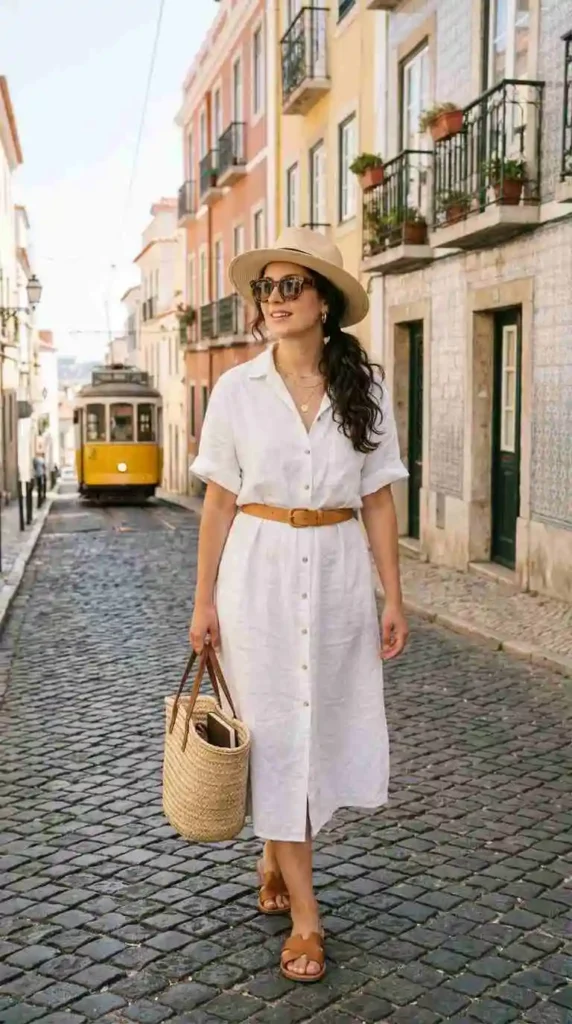
Lisbon in summer is a city for linen dresses and the linen dress that works here is the one that has been built for serious heat and serious walking simultaneously.
A linen shirt dress or a simple A-line linen dress — midi length, breathable, in a colour that works against Portuguese architecture: warm cream, natural linen, terracotta, soft cobalt, warm white. Flat leather sandals that have been properly broken in. A crossbody leather bag in tan or cognac. Sunglasses that you will wear from the moment you leave the accommodation until you return to it.
The midi length matters specifically in Lisbon. The hills and the frequent stair-climbing of the miradouros — the viewpoints scattered across the city’s hills — make any length that risks exposure on a staircase or steep incline less comfortable to wear confidently throughout a full day. The midi handles all of this without modification.
The linen dress in Lisbon photographs against the azulejo tile facades that line every street in the historic neighbourhoods in a way that makes the colour choice feel like it was planned: the warm cream against blue and white tile, the terracotta against the geometric patterns of the traditional Portuguese ceramic work, the cobalt against the warm ochre of Lisbon’s older walls.
This is the essential Lisbon outfit. Everything else in this guide is a variation on its principles.
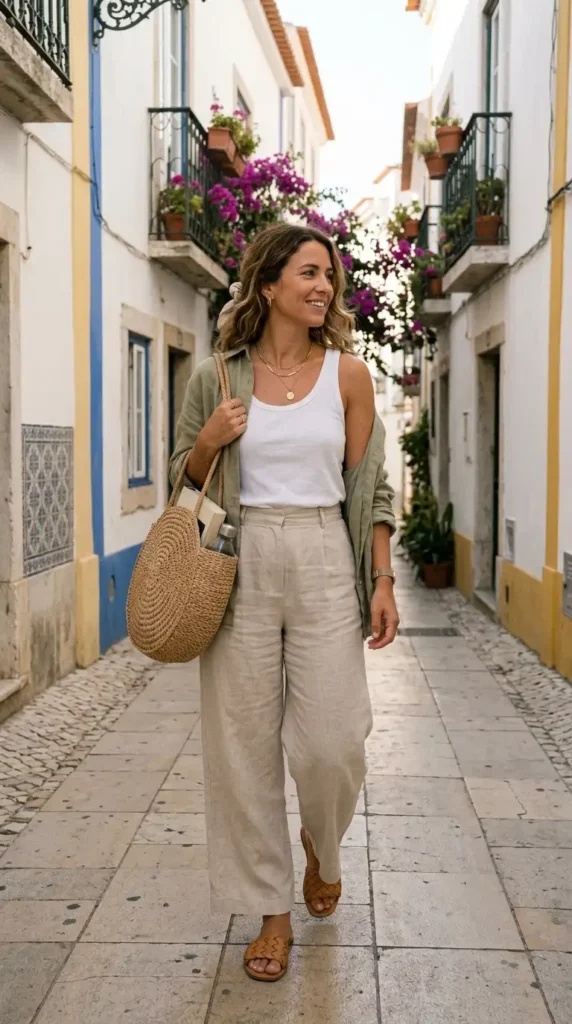
02. The Wide-Leg Linen Trouser and Simple Top
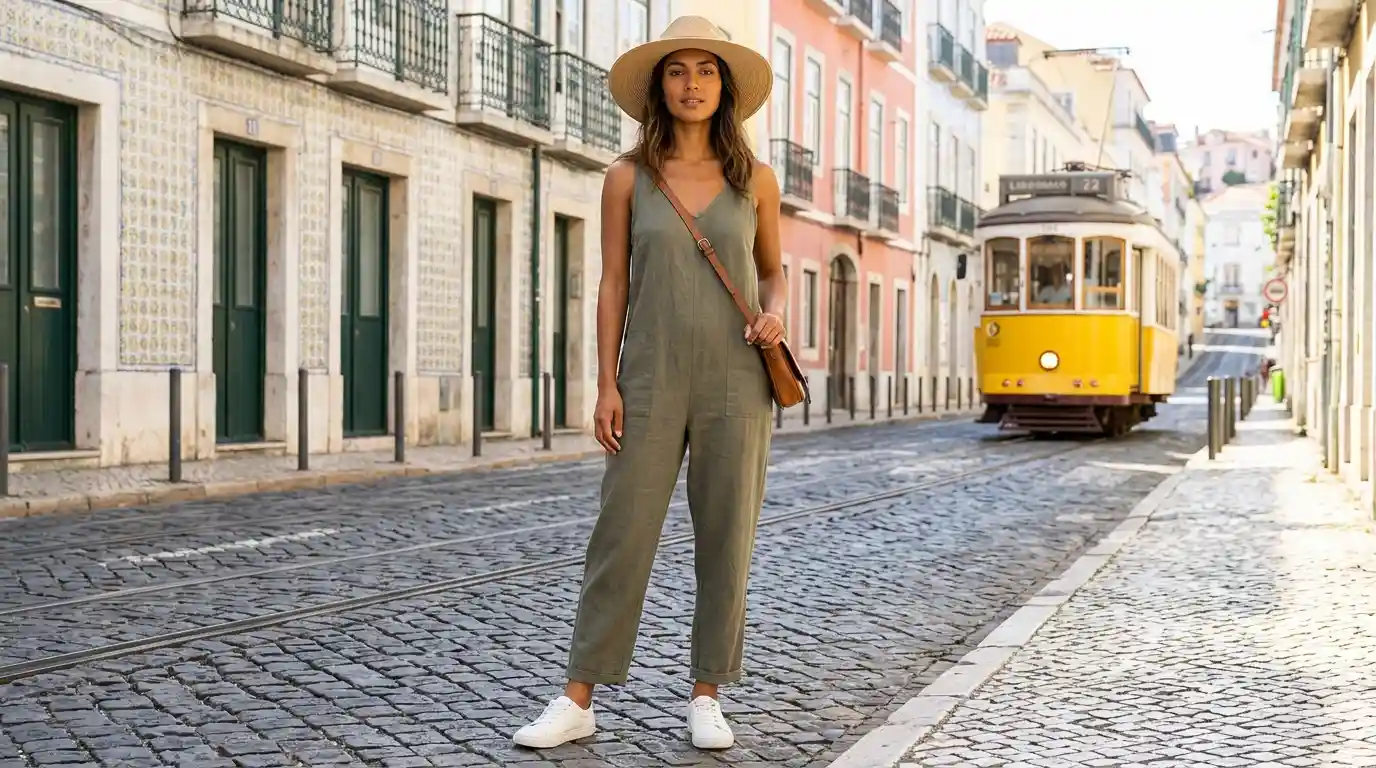
The wide-leg linen trouser is the Portugal travel bottom that handles the full range of the country’s demands most completely.
A wide-leg or barrel-leg linen trouser in a neutral summer tone — warm cream, natural linen, stone, soft camel, pale sage — with a simple fitted top: a linen tank, a cotton camisole, a simple fitted tee. Flat leather sandals. A crossbody or structured shoulder bag.
The wide-leg linen trouser walks the Lisbon hills without restriction. It breathes in Algarve heat. It reads as smart casual in the Douro Valley wineries. It converts to an evening outfit with a silk camisole and a slight heel. It is the single most versatile bottom in a Portugal travel wardrobe.
The natural linen colour is the most specifically Portuguese of all the trouser options — it photographs against the warm stone and terracotta of Portuguese architecture as if it was chosen for the backdrop rather than the wardrobe. Which, in the best Portugal travel dressing, amounts to the same thing.
03. The Stripe Top and White Jeans for Porto
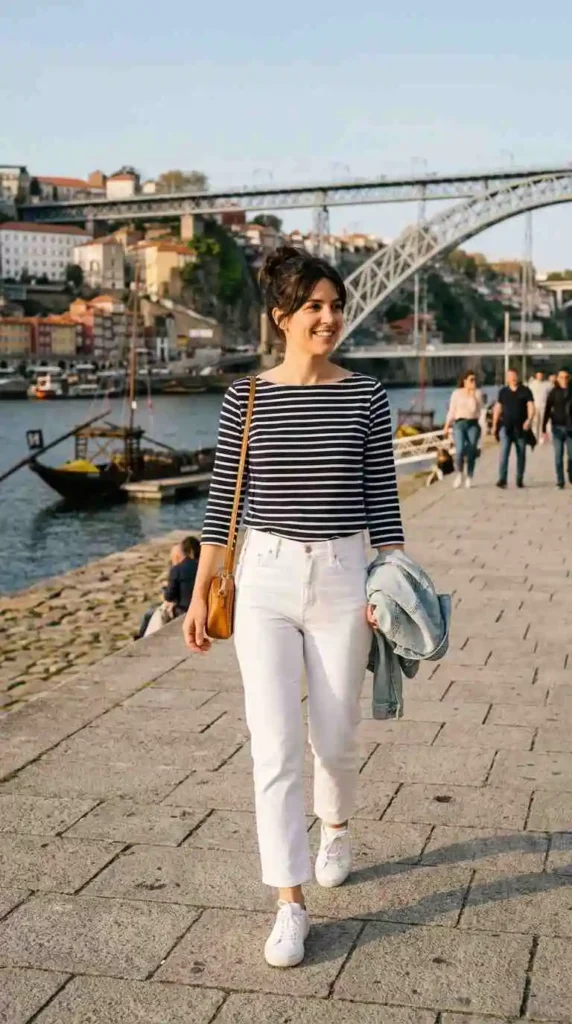
Porto is the Portuguese city with the most Atlantic-European character — cooler, breezier, with a distinct northern Portuguese identity that feels different from Lisbon’s Mediterranean warmth.
The Porto outfit: a navy and white Breton stripe top — fitted or slightly relaxed, quality cotton — with white straight-leg jeans and leather trainers or clean leather loafers. A crossbody bag in tan or black. A lightweight jacket or linen blazer in the bag for the Atlantic wind that arrives off the river in the afternoon.
Porto’s riverfront — the Ribeira district with its coloured facades and its rabelo boats on the Douro — is the backdrop that makes this combination look specifically right. The stripe references the maritime character of a city that has been a trading port since the twelfth century. The white jeans photograph against the colourful facades of the Ribeira in the way that white always photographs against colour — by making everything around it more vivid.
The linen blazer is the Porto layer. The city’s Atlantic exposure means that the wind off the river and the cooler northern temperatures require a layer that Lisbon in August does not.
04. The Terracotta Outfit — Dressing for Portuguese Light
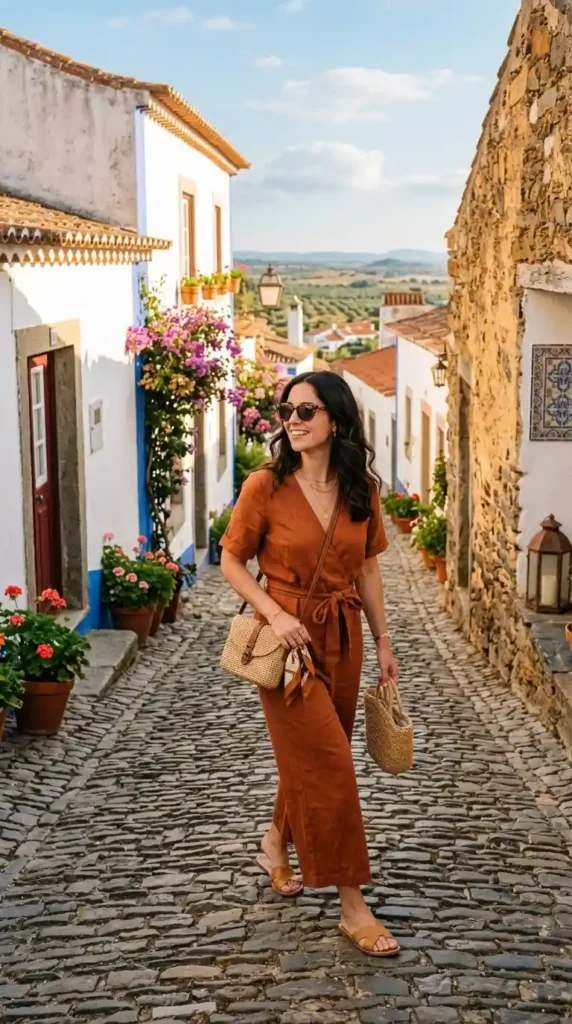
Portugal’s light has been described as the most beautiful in Europe by painters and writers for several centuries and if you have seen what it does to the colour terracotta you understand why.
A terracotta outfit — a terracotta linen dress, or terracotta wide-leg trousers with a cream or white top, or a terracotta co-ord in linen — against the Portuguese landscape and architecture is the colour combination that looks as if it was designed by someone who knew exactly what the light was going to do with it.
Terracotta in Portuguese light does not read as earthy or muted. It reads as luminous — specifically warm, specifically alive in a way that the same colour in northern European light or indoor light does not achieve. The golden afternoon light of Lisbon, the warm evening light of the Douro Valley, the direct midday light of the Algarve coast — all of them make terracotta more itself.
Wear it simply. A terracotta linen dress with flat leather sandals and a minimal bag needs nothing added. The colour does the work. The Portuguese light does the rest.
Read more about: Paris Travel Outfits: What to Actually Wear in the Most Stylish City in the World
05. The Algarve Beach Outfit
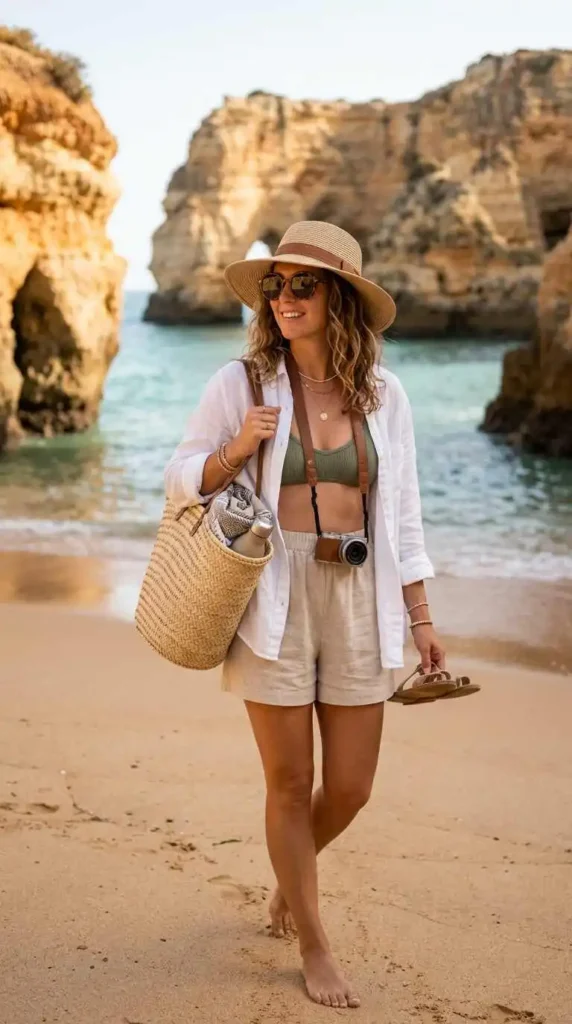
The Algarve coast is the beach destination of mainland Europe — the golden limestone cliffs, the sea caves, the small sandy coves accessible only by boat or by climbing down cliff paths, the long sandy beaches flanked by the distinctive orange and white rock formations that make the Algarve visually unlike any other European coastline.
The Algarve beach outfit: a quality swimsuit in a colour that feels right for the person wearing it, with a linen shirt or linen shirt dress as the cover-up that also walks into the beachfront café and the small coastal village without requiring a change. Flat leather sandals or espadrilles. A woven basket bag large enough for beach essentials. A good hat — the Algarve midday sun is direct and serious and the cliff-walk between coves offers no shade.
The cover-up is the critical piece. The linen shirt dress or oversized linen shirt that converts from beach cover-up to café outfit to village exploration outfit in a single garment is the Algarve packing efficiency principle applied to a specific garment. One piece. Multiple contexts. No changes required.
06. The Cobalt Blue Dress
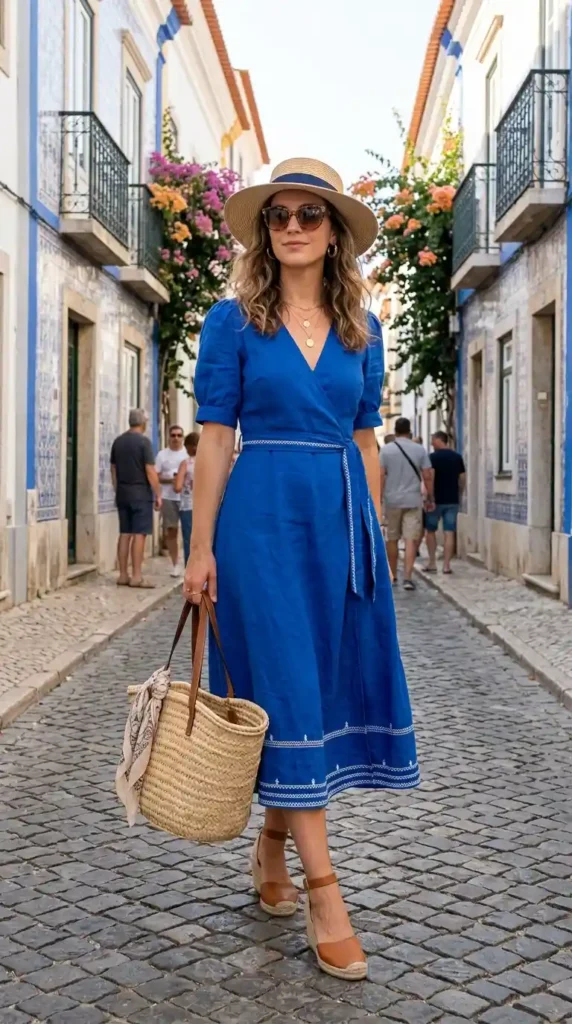
Cobalt blue in Portugal is not a fashion choice. It is a response to the country.
The azulejo tiles that cover the facades of Portuguese buildings — from the 15th-century tilework of Lisbon’s churches to the Art Nouveau tile facades of Porto’s Bolhão market to the painted tile scenes on the walls of the São Bento railway station — are blue and white. The Atlantic that borders Portugal’s entire western coast is cobalt in the specific light of the Portuguese coast. The sky above the Algarve cliffs on a clear summer morning is the most saturated blue available to anyone who is not looking at a photograph of it.
A cobalt blue dress in Portugal — a linen midi, a simple cotton sundress, a silk dress for evening — is the colour choice that photographs against every Portuguese backdrop with the particular rightness of a colour that belongs in its setting.
Flat sandals in natural or tan leather. A minimal woven bag. Gold jewellery. This is the outfit that looks like it was planned by someone who understood that the most sophisticated colour choice is the one that responds to where you are.
Read more about: Adidas Outfit Ideas for Women: The Complete Style Guide
07. The Portuguese Evening Outfit — Fado and Fine Dining
Lisbon in the evening is specific.
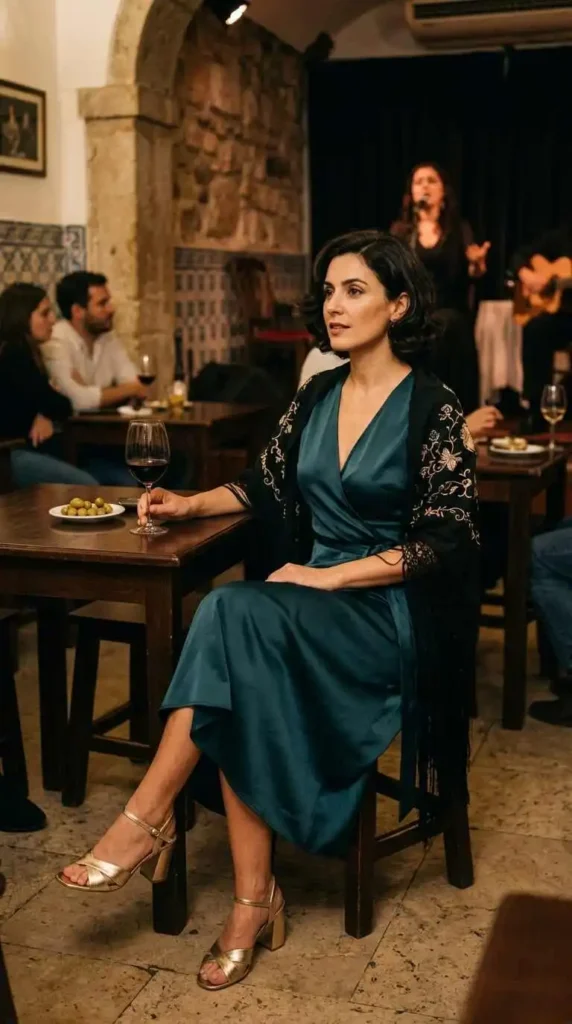
The fado restaurants — the intimate venues in Alfama and Mouraria where Portugal’s most distinctive musical tradition is performed over long dinners — require a level of dressing that respects the occasion without demanding formality. The rooftop bars above Lisbon’s miradouros, where the city spreads out below and the Tagus is visible in the distance, have their own register. The restaurant in Porto’s Foz district by the Atlantic has another.
The Portuguese evening outfit: a silk midi dress or a silk blouse with wide-leg tailored trousers in a quality fabric. Leather mules with a slight heel or strappy flat sandals. A minimal leather bag. Gold jewellery — a chain, simple earrings, one ring. Hair that has been considered.
This is not a formal outfit. Portuguese evenings rarely require formality. It is a considered outfit — one that acknowledges the quality of what the evening is offering and dresses for it accordingly.
The fado evening specifically: dark colours work better than pale ones for the intimate, candlelit, emotionally intense atmosphere of a fado restaurant. Deep cobalt, warm burgundy, forest green, or the classic black — all of these sit correctly in the fado context. Cream and white belong at the lunch table, not the fado dinner.
08. The Douro Valley Wine Country Outfit
The Douro Valley is the wine region that extends east from Porto along the valley of the Douro River — the terraced vineyards, the quintas, the river bends that produce the most photographed landscape in Portugal.
A winery visit in the Douro Valley is not a formal occasion and not an entirely casual one. It is the specific register of a considered afternoon in a beautiful wine region — comfortable for walking between vine rows and tasting rooms, appropriate for the lunch that typically follows the cellar tour, smart enough for the quinta’s terrace overlooking the river at sunset.
The Douro outfit: wide-leg linen trousers in a warm neutral with a simple linen blouse or a well-cut fitted top. Flat leather shoes or leather sandals — the quintas involve walking on uneven ground and occasionally on loose stone, making any heeled option impractical. A structured bag. A lightweight layer for the quinta’s wine cellar, which is cool regardless of the temperature outside.
The hat is non-negotiable in the Douro Valley in summer. The valley runs east-west and the terraced south-facing slopes that create the conditions for port wine production also create direct, intense sun exposure for anyone walking between rows of vines. Wear one. It will look appropriate rather than touristy against the vineyard backdrop.
Read more about: Rave Outfit Ideas for Women: The Complete Style Guide for Every Festival and Event
09. The Sintra Day Trip Outfit
Sintra — the UNESCO World Heritage town thirty kilometres west of Lisbon — is the most visited day trip destination in Portugal and one of the most beautiful small towns in Europe.
The Pena Palace rising above the forest on its rocky crag. The Moorish Castle walls running along the ridgeline. The gardens and fountains of the Quinta da Regaleira. The old town with its pastry shops selling the traditional travesseiros and queijadas that have been made here since the nineteenth century.
Sintra requires specific consideration. The town centre sits at a lower elevation. The palaces and the castle are reached by steep roads and significant walking. The forest between them is beautiful and cool but the exposed ridgeline sections are very much in the sun.
The Sintra outfit: comfortable walking shoes that can manage steep, sometimes slippery stone paths. Wide-leg linen trousers or a midi dress that moves freely on uneven terrain. A lightweight layer for the forest sections that are surprisingly cool. A hat for the exposed ridgeline walks. A crossbody bag that stays on the shoulder without requiring hands.
This is the practical outfit applied to one of the most beautiful settings in Europe. The setting does the visual work. The outfit needs only to be correct and comfortable for the terrain.
10. The White Outfit for the Alentejo
The Alentejo — the vast, underpopulated interior plain that occupies much of southern Portugal — is the part of the country that most visitors never reach and that rewards the ones who do more consistently than any other Portuguese region.
The cork oak forests. The whitewashed hill towns — Évora, Monsaraz, Marvão — sitting on ridgelines above the plains with their medieval walls and their Roman history. The long, straight roads between them lined with cork oaks and olive trees. The quality of silence that a sparsely populated landscape in summer heat produces.
The Alentejo outfit: white. Simply white. A white linen dress or white wide-leg linen trousers with a white linen top, worn in the heat of a Portuguese inland summer against the whitewashed walls of an Alentejo hill town or the silver-grey of the cork oak forests.
The Alentejo hill towns are built of white — white walls, white plasterwork, white streets that reflect the heat and the light. White clothing against white architecture is not a contrast. It is an agreement — the outfit that belongs completely to its setting because it was made from the same colour as the walls.
Flat leather sandals. A woven bag. Gold jewellery. Nothing more required.
Read more about: What to Wear in France in Summer: The Complete Women’s Style Guide
11. The Linen Co-ord for Portuguese Cities
The matching linen co-ord — wide-leg trouser and oversized shirt or relaxed blazer in the same fabric and colour — is the Portuguese city outfit that reads as the most intentional.
In a terracotta, warm cream, sage green, or natural linen colourway it works in every Portuguese city context from morning exploration to afternoon museum visit to evening aperitivo. The co-ord pieces together create the intentional ensemble. Separated — the trouser with a different top, the shirt over a simple dress — they create additional outfits from the same two pieces already in the bag.
This is the Portugal packing efficiency principle applied to a specific outfit category. The linen co-ord in a warm Portuguese colour is two pieces that create three or four outfits when combined with other pieces in the bag.
Wear with flat leather sandals and a minimal crossbody bag for the city exploration version. With leather loafers and a structured bag for the smart casual version. With leather mules for the evening version.
The co-ord is the outfit that requires the least thought on the day and produces the most consistent results. In a country as beautiful as Portugal, less time thinking about the outfit means more attention available for the country.
Read more about: 13 Italian Summer Outfit Ideas: What to Actually Wear in Italy This Summer
12. The Sustainable Linen Wardrobe — Dressing for Portugal’s Values
Portugal is one of Europe’s most committed countries in terms of sustainable textile production. The Portuguese textile industry — based primarily in the Braga and Porto region of the north — produces some of the finest linen and cotton fabrics in the world using increasingly sustainable methods. The country’s relationship with its textile heritage goes back centuries.
Choosing natural, sustainable fabrics for a Portugal trip is not merely a practical choice — it is a choice that aligns with the values of the country being visited. Linen grown and processed in Portugal. Cork leather accessories — Portugal produces sixty percent of the world’s cork and the accessory industry built on it produces bags, shoes, and wallets that are genuinely beautiful and genuinely sustainable.
A cork leather bag — light, water-resistant, and specific to Portugal — is the accessory that is simultaneously the most practical and the most culturally appropriate souvenir and travel companion available. Buy one on the first day. Use it for the entire trip.
13. The Porto Rainy Day Outfit
Porto is not Lisbon and it is not the Algarve. It is a northern Atlantic city and it rains in Porto in a way that southern Portugal does not experience.
Even in summer, Porto’s Atlantic exposure brings grey days and occasional rain — not the long, drenching rains of autumn and winter, but the short, sharp Atlantic showers that can arrive at noon on a day that was clear at nine in the morning.
The Porto rainy day outfit: a quality waterproof jacket — not a fashion jacket with aspirations of waterproofing but an actually waterproof outer layer in a neutral colour — over a simple linen or cotton outfit. Leather ankle boots or leather trainers that can handle wet cobblestones without becoming damaged. A leather bag rather than a woven or canvas bag. The trench coat if it is properly waterproofed.
Porto in the rain is beautiful. The Ribeira district with the Douro reflecting the grey sky and the coloured facades glowing against it. The tile facades of the historic buildings with the rain running over their surfaces. The interior of the Livraria Lello — the extraordinary bookshop that is one of the finest interiors in Portugal — full of visitors who came in from the rain and stayed for the beauty.
The Porto rainy day outfit is the outfit that lets you be outside in the rain without being ruined by it. Porto in rain rewards the person who is dressed for it.
Read more about: What to Wear in France in Summer: The Complete Women’s Style Guide
Practical Tips for Dressing in Portugal
Break in every shoe before Lisbon. This advice appears in every Portugal guide that takes footwear seriously because it is the most important practical tip available to any Lisbon visitor. The hills are steep and long and covered in uneven stone that requires shoes with genuine grip and genuine cushioning. New shoes on Lisbon hills is a specific kind of suffering that ruins the afternoon of the most beautiful city in Europe. Wear every shoe for a full day before departure.
The cork accessory is worth buying. Portugal’s cork industry produces bags, wallets, and accessories that are light, durable, water-resistant, and specific to the country. A cork leather crossbody bag weighs almost nothing, handles rain without damage, and is the most specifically Portuguese accessory available. Buy one in Lisbon or Porto. Use it for the rest of the trip.
Sunscreen on Lisbon’s hills. The viewpoints — the miradouros — that make Lisbon’s rooftop geography so extraordinary are exposed, elevated, and in direct sun for most of the day. Apply SPF before leaving the accommodation and carry it in the bag for reapplication. The altitude and the exposure of the hilltop viewpoints make sunburn faster than ground level suggests.
The layer for Porto evenings. Even in summer, a Porto evening along the Douro riverfront runs cool. A linen blazer or a lightweight jacket in the bag handles the temperature drop that arrives after sunset on the Atlantic coast.
Respect the church dress code. Portugal’s extraordinary religious architecture — the Jerónimos Monastery, the Batalha Monastery, the churches of Évora and Braga — requires covered shoulders and appropriate lengths. A lightweight scarf large enough to cover the shoulders, carried in the bag at all times, handles every Portuguese religious site without requiring a separate wardrobe.
The Portugal Outfit Colour Palette
The Portugal colour palette is built on the country’s own visual character — the colours of its tiles, its architecture, its landscape, and its extraordinary light.
The foundation: warm cream, natural linen, warm white, and stone. These are the neutral tones of Portuguese whitewashed architecture and the Alentejo plains. They photograph against every Portuguese backdrop with the clean brightness that the country’s light creates.
The Portuguese accent colours: terracotta — the colour of Portuguese roof tiles and the clay of the south. Cobalt blue — the colour of the azulejo tile tradition that appears everywhere in the country. Warm sage green — the colour of the cork oak forests of the Alentejo. Warm gold — the colour of the Douro Valley’s terraced vineyards in late afternoon light.
The Atlantic tones: navy, dark teal, and the grey-blues of the Atlantic coast. These are the Porto and coastal colours — cooler, more northern, specifically appropriate for the Atlantic-facing parts of the country.
The evening tones: deep cobalt, warm burgundy, forest green. These are the dinner and fado colours — rich, warm, appropriate for the candlelit intimacy of a Portuguese evening in the old city.
Build the Portugal wardrobe from these colours and every piece responds to the country it is worn in. The light takes care of the rest.
Read more about: UK Festival Outfit Ideas: 15 Stylish and Practical Looks for Every British Festival
Final Thoughts
Portugal is the European destination that surprises people most consistently.
You arrive expecting a smaller, less fashionable version of Spain or a warmer version of the Atlantic north and you find instead a country with its own completely distinct identity — its own light, its own music, its own architectural tradition, its own relationship to the sea and the history of exploration that the sea made possible.
The Portuguese light — the saudade light, the light that the country’s poets have been writing about for centuries — is the light that makes every photograph taken in it look better than the photographer’s skill alone explains. It is the light that makes the right outfit look specifically and completely right and the wrong outfit look more wrong than it would anywhere else.
Dress for Portugal the way you dress for any destination that takes beauty seriously. With care but without overthinking. With the right fabrics for the heat and the hills and the Atlantic wind. With the colours that respond to the azulejo tiles and the terracotta rooftops and the extraordinary golden light of a Portuguese afternoon.
Wear comfortable shoes. Buy a cork bag. Take the photograph from the miradouro.
Portugal will do the rest.
Go slowly. Dress well. Let the light find you in the right clothes.
Read more about: Back to School Outfit Ideas: 15 Stylish and Comfortable Looks for Every First Day