Things to Do in Manchester: The Complete Guide to Britain’s Most Exciting City

There is a city in the north of England that has been quietly — and sometimes not so quietly — one of the most interesting places in Britain for the better part of two centuries.
It powered the Industrial Revolution. It gave the world the suffragette movement. It produced the Hallé Orchestra, the BBC Philharmonic, and some of the most important music of the twentieth century. The Smiths. Oasis. The Stone Roses. Joy Division. New Order. The Haçienda. Electronic music as the world came to know it was partly invented in a converted yacht showroom on Whitworth Street.
Manchester United and Manchester City between them have shaped global football culture in ways that extend far beyond sport.
And the city has reinvented itself in the past three decades into something genuinely extraordinary. World-class museums. A restaurant scene that rivals London in quality if not in quantity. Neighborhoods that each have their own distinct character and energy. A cultural confidence that comes from a city that has always known its own worth.
This is the complete guide to experiencing all of it.
Read more about: Best Castles in Europe: The Ultimate Guide to History’s Most Stunning Fortresses
Before You Go: What to Know About Manchester
Manchester sits in the northwest of England in the county of Greater Manchester. It is the third most visited city in the UK after London and Edinburgh and it deserves every visit it receives.
The city centre is compact and walkable. Most of the major attractions, neighborhoods, and restaurants are accessible on foot from the city centre hotels. The Metrolink tram network extends the range considerably and is one of the finest urban tram systems in the UK.
Manchester has a reputation for rain that is both deserved and exaggerated. It does rain in Manchester. More than London. More than most English cities. But it rains with a particular efficiency — often short, sharp showers rather than prolonged grey drizzle — and the city carries on through it with complete indifference.
A waterproof layer is not optional in Manchester. It is part of the dress code.
The people are among the friendliest in Britain. Mancunians have a directness and warmth that visitors consistently comment on. Conversations with strangers happen here in a way that they do not in London. Embrace it.
And eat. Manchester’s food scene has transformed completely in the past decade. From the extraordinary Northern Quarter independent restaurants to Chinatown to the Mackie Mayor food hall to the Mana restaurant that holds Manchester’s first Michelin star in decades. Eat as much as possible of all of it.
Read more about: Things to Do in Spain: The Ultimate Travel Guide to an Unforgettable Trip
The Best Neighborhoods in Manchester
Understanding Manchester’s neighborhoods is the key to understanding the city.
The Northern Quarter
Explore the Northern Quarter
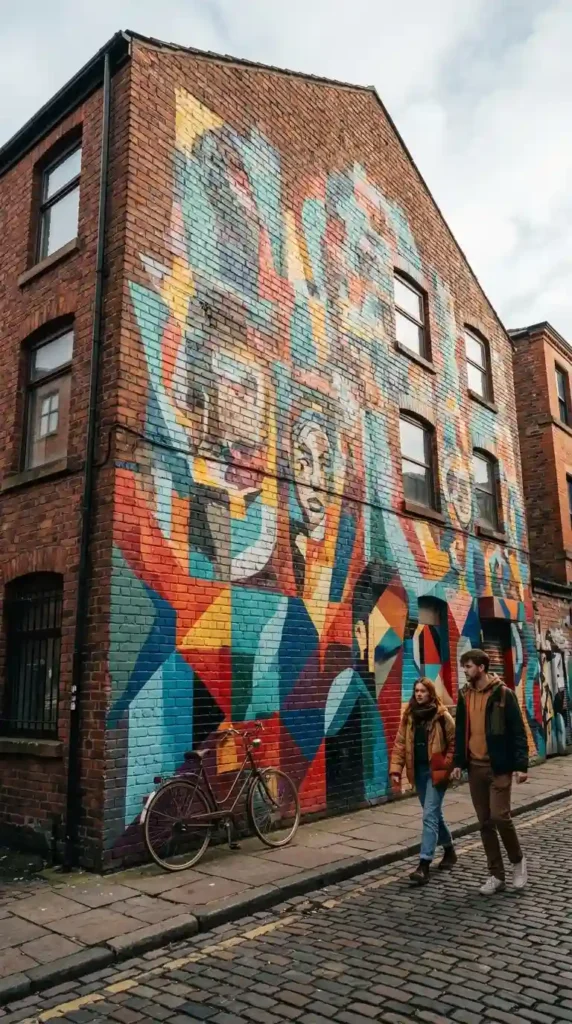
The Northern Quarter is Manchester’s creative heart and one of the finest urban neighborhoods in the UK.
A grid of streets between Piccadilly and the old textile warehouse district packed with independent record shops, vintage clothing stores, coffee shops that take their coffee as seriously as anywhere in the world, bookshops, galleries, and some of the finest independent restaurants in the city.
Afflecks — the multi-story independent market in a converted warehouse — is a Manchester institution. Four floors of independent traders selling vintage clothing, records, handmade jewelry, art prints, and the kind of things that cannot be found anywhere else. It has been here for decades and it remains one of the finest examples of independent retail culture in Britain.
The Northern Quarter is best explored slowly. On foot. With no particular agenda. Allow a full morning or afternoon and let the neighborhood reveal itself at its own pace.
Eat and Drink in the Northern Quarter
The Northern Quarter has the highest concentration of independent restaurants and bars in Manchester.
Elnecot on Cutting Room Square. Elnecot opened in a converted Victorian textile warehouse and its food is among the finest in the city. The Hawksmoor on Deansgate for the finest steak in Manchester. Refuge by Volta in the Principal Hotel for one of the most beautiful dining rooms in the North of England.
For coffee: Takk on Tariff Street is one of the finest independent coffee shops in the UK. Federal Café and Bar on Nicholas Croft for Australian-influenced coffee culture. Pot Kettle Black on Barton Arcade for coffee in one of Manchester’s most beautiful Victorian shopping arcades.
For bars: the Nothern Quarter has more interesting bars per square metre than almost anywhere outside London. Bunny Jackson’s. The Deaf Institute. Soup Kitchen. Each with its own character.
Read more about: Best Things to Do in Switzerland: The Complete Travel Guide
Ancoats
Discover Ancoats: Manchester’s Coolest Neighborhood
Ancoats was the world’s first industrial suburb. The cotton mills that powered the Industrial Revolution were built here in the early nineteenth century and the neighborhood bears the architecture of that history in every direction.
In the past decade it has transformed into Manchester’s most interesting neighborhood. Converted mill buildings now house the finest restaurants in the city alongside apartments, creative studios, and the kind of independent retail that follows creative energy wherever it settles.
Eat at Mana
Mana on Blossom Street in Ancoats holds Manchester’s first Michelin star in decades and is one of the finest restaurants in the UK.
Chef Simon Martin’s tasting menu is a genuinely extraordinary dining experience. The converted railway arch space adds to an atmosphere that is formal enough to feel like an occasion and relaxed enough to feel genuinely welcoming.
Book months in advance. This is not an exaggeration.
Explore Cutting Room Square
Cutting Room Square in the heart of Ancoats is the neighborhood’s focal point. Surrounded by converted Victorian mill buildings now housing restaurants, bars, and independent businesses.
The square has a particular quality in the early evening when the restaurants are filling and the light is falling on the old brick and the whole neighborhood feels simultaneously historic and completely alive.
Sit outside at any of the restaurants facing the square and spend the hour watching the neighborhood move around you. It is one of the finest things you can do in Manchester.
Castlefield and Deansgate
Walk the Castlefield Canal Basin
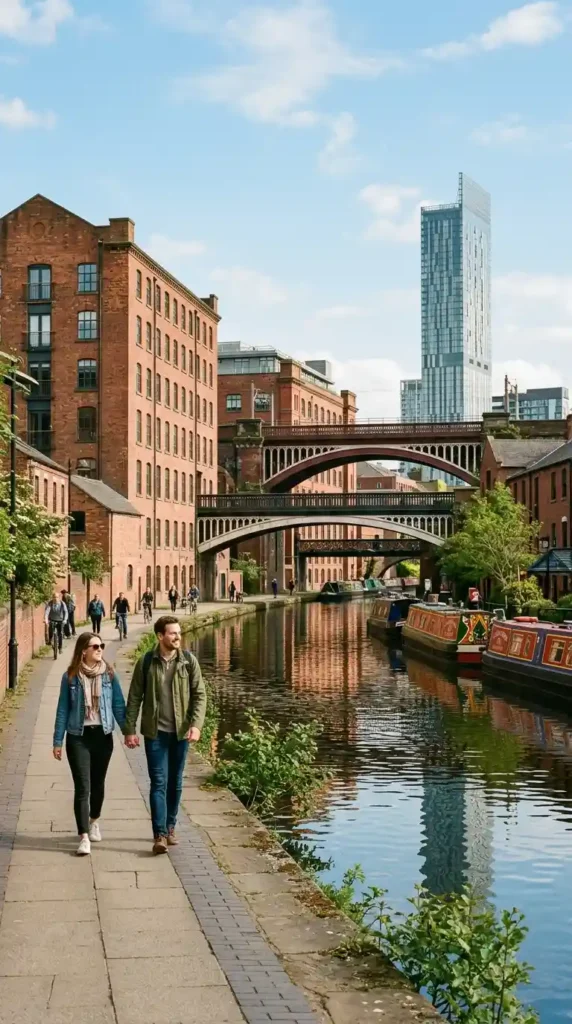
Castlefield is the oldest part of Manchester. Roman fort remains sit alongside the world’s first industrial canal junction — where the Bridgewater Canal meets the Manchester and Salford Junction Canal — creating a landscape of extraordinary industrial heritage in the heart of the city.
The canal basin is surrounded by converted warehouses and Victorian railway viaducts that create one of the most distinctive urban landscapes in the North of England. Bars and restaurants occupy the spaces under the arches and beside the water.
Walk the canal towpaths in both directions from the basin. The walk toward Salford along the Bridgewater Canal is particularly beautiful in the late afternoon.
Visit the MOSI
The Museum of Science and Industry in Castlefield occupies the site of Liverpool Road Station — the world’s first passenger railway station — and tells the story of Manchester’s extraordinary industrial and scientific history.
The Textiles Gallery. The Energy Hall with its working Victorian steam engines. The Space Gallery. The Air and Space Hall with its collection of aircraft.
The MOSI is free. Allow at least three hours. The building itself — Victorian railway architecture on an extraordinary scale — is as interesting as the collection inside it.
Read more about: Things to Do in Chicago: A Real Traveler’s Guide
The Best Cultural Attractions in Manchester
Museums and Galleries
The Manchester Art Gallery
The Manchester Art Gallery on Mosley Street holds one of the finest regional art collections in the UK.
Pre-Raphaelite paintings in extraordinary depth and quality. An important collection of British and European art from the sixteenth century to the present. Temporary exhibition spaces that bring some of the most significant touring exhibitions in the country to Manchester.
The gallery is free. The building — a nineteenth century neoclassical structure that was the city’s first public art gallery — is itself worth visiting.
Allow two hours for the permanent collection. More if there is a significant temporary exhibition during your visit.
The Whitworth
The Whitworth on Oxford Road near the University of Manchester is one of the finest gallery buildings in the UK after a transformative renovation completed in 2015.
Its collection spans textiles and wallpapers — extraordinary in scope and quality — alongside fine art, prints, and an important collection of works on paper.
The building itself — a Victorian gallery extended by a contemporary glazed structure that opens directly onto Whitworth Park — creates one of the most beautiful gallery environments in the North of England.
Free admission. Allow two hours.
HOME Manchester
HOME on First Street is Manchester’s centre for international contemporary theatre, film, and visual art.
Five cinema screens showing independent, foreign language, and documentary films. Two theatre spaces producing original work and hosting touring productions. Gallery spaces with contemporary art exhibitions.
HOME is one of the most important cultural venues in the North of England and one of the finest examples of arts centre programming anywhere in the UK. Check the programme before you visit and book for whatever looks most interesting.
Read more about: Things to Do in Nashville: The Only Guide You Actually Need
The John Rylands Library
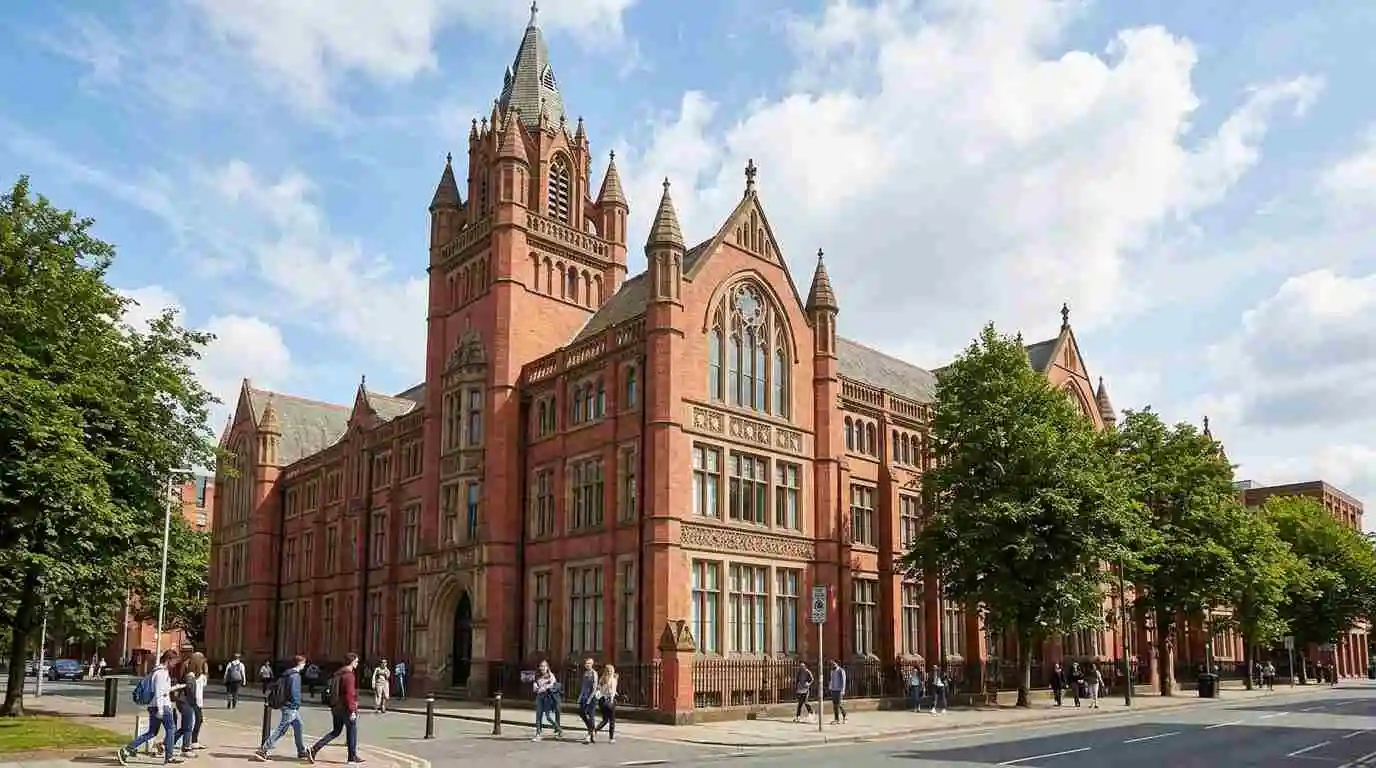
The John Rylands Library on Deansgate is one of the most extraordinary buildings in Manchester and one of the most beautiful Victorian Gothic buildings in the UK.
Built in 1900 as a memorial to textile merchant John Rylands by his widow Enriqueta, it houses one of the finest collections of rare books and manuscripts in the world.
The reading room — a soaring Gothic space of extraordinary architectural refinement — is available to visit for free. The collection includes a Gutenberg Bible, papyri from ancient Egypt, and manuscripts spanning 5000 years of human writing.
Go in the morning when the light comes through the Gothic windows at the most beautiful angle.
Music and Culture
Follow the Manchester Music Trail
Manchester’s contribution to popular music is extraordinary and the city wears that heritage with justified pride.
The Factory Records story. The Haçienda on Whitworth Street West where house music arrived in Britain in the late 1980s. The Lesser Free Trade Hall where the Sex Pistols played in 1976 to an audience that reportedly included members of Joy Division, The Smiths, and The Fall. The Boardwalk where Oasis played their early shows.
A self-guided walking tour following these locations takes half a day and provides a genuine understanding of why Manchester produced what it produced and how the physical and cultural geography of the city shaped the music.
The Manchester Music Tour company runs excellent guided versions of this walk. Book in advance.
Visit the Manchester Arena and AO Arena
The AO Arena — formerly the Manchester Evening News Arena and before that the Nynex Arena — is the largest indoor arena in Europe and one of the busiest music venues in the world.
If any significant touring artist or band is performing in the UK they will play the AO Arena at some point during the tour. Check the programme well in advance. Shows sell out quickly.
The Manchester Apollo on Stockport Road is the intimate venue counterpart. Capacity of approximately 3500. Sight lines and acoustics that make it one of the finest mid-size music venues in Britain.
Read more about: 25 Best Things to Do in Copenhagen: My Personal 2026 Travel Guide
The Hallé at the Bridgewater Hall
The Hallé Orchestra is the oldest professional symphony orchestra in the UK founded in 1858 by the German conductor Charles Hallé.
The Bridgewater Hall on Lower Mosley Street is their home. A concert hall of extraordinary acoustic quality that opened in 1996 and remains one of the finest purpose-built concert halls in Britain.
The Hallé’s season runs from September to June with occasional summer concerts. Tickets are considerably more affordable than comparable London concerts. The programming covers the full classical and romantic repertoire alongside contemporary commissions and popular concert events.
Even for visitors with only a passing interest in classical music a Hallé concert in the Bridgewater Hall is an experience worth having.
Sport in Manchester
Old Trafford: Manchester United
Old Trafford is the most visited football stadium in England and one of the most famous sporting venues in the world.
The Theatre of Dreams. Capacity of 74,000. Home to Manchester United since 1910. The stadium tour — running daily on non-match days — takes visitors through the dressing rooms, the tunnel, the dugout, the media facilities, and the museum telling the story of one of the most successful clubs in football history.
Book stadium tours in advance online. Match tickets require booking months or sometimes years in advance through the official club channels for the most significant games.
The Etihad: Manchester City
The Etihad Stadium in east Manchester is the home of Manchester City and one of the finest stadium experiences in the Premier League.
City’s recent period of sustained success — multiple Premier League titles, a Champions League trophy — has made the Etihad one of the most exciting match day experiences in European football.
Stadium tours run on non-match days and include the dressing rooms, the tunnel, and the City Football Academy facilities.
The National Football Museum
The National Football Museum in the Urbis building in the city centre tells the story of football as a cultural and sporting phenomenon with Manchester as its appropriate home.
Interactive exhibits covering the history of the game from its nineteenth century origins to the present. Match worn shirts, historic programmes, trophies, and memorabilia spanning the full history of English football.
Free admission. Allow two hours.
Read more about: 10 Best Things to Do in Cinque Terre: A Colorful Italy Guide
The Best Food and Drink in Manchester
Manchester’s food scene has transformed beyond recognition in the past decade and eating well here is one of the great pleasures the city offers.
The Mackie Mayor Food Hall
The Mackie Mayor in the Northern Quarter occupies a beautiful Victorian meat market building on Eagle Street and houses some of the finest street food traders in Manchester under one historic roof.
Elnecot’s smaller format counter. Honest Crust pizza. El Gato Negro’s tapas counter. A bar serving natural wines and craft beers.
The building alone — restored Victorian cast iron and glazing on a remarkable scale — is worth visiting. The food makes it essential.
Go for lunch or early evening. It fills quickly on weekends.
Chinatown
Manchester’s Chinatown is the second largest in the UK after London and one of the finest Chinese restaurant clusters outside China itself.
The area around Faulkner Street and Nicholas Street contains restaurants specializing in every Chinese regional cuisine alongside Vietnamese, Korean, and Japanese restaurants that benefit from the neighborhood’s Asian food culture.
Yang Sing on Princess Street has been the finest Cantonese restaurant in Manchester for decades. Little Yang Sing next door is the more casual and slightly more affordable sister restaurant.
Go for Sunday dim sum. Arrive early. The best dishes go first.
Bundobust Manchester
Bundobust on Oxford Street combines craft beer with Indian street food in a combination that sounds simple and delivers something extraordinary.
The okra fries. The dhal puri. The bhel puri. All of it made with the care and quality of a serious kitchen without the formality of a sit-down restaurant.
Queue for a table on weekends. It is worth it completely.
The Didsbury and Chorlton Restaurant Scenes
The south Manchester suburbs of Didsbury and Chorlton have developed restaurant scenes that rival the city centre in quality and exceed it in relaxed neighborhood charm.
Didsbury’s Lapwing Lane and the village centre are dense with independent restaurants and wine bars. Chorlton’s Beech Road has the finest concentration of independent food and drink in suburban Manchester.
Take the Metrolink tram to either neighborhood for an evening. The contrast with the city centre energy is part of the pleasure.
Read more about: 8 Best Things to Do in Florence: The Ultimate Travel Itinerary
Day Trips from Manchester
Manchester’s location in the northwest makes it one of the finest bases for day trips in England.
The Peak District
The Peak District National Park begins approximately 30 minutes from Manchester city centre by car or train.
The Dark Peak — the wilder, higher northern section of the park with its moorland plateaus and dramatic gritstone edges — is directly accessible. Kinder Scout. The Snake Pass. Bleaklow. These landscapes are extraordinary and completely wild within an hour of one of England’s largest cities.
The White Peak to the south offers gentler limestone dales, historic market towns like Bakewell and Castleton, and the kind of English countryside walking that has no equivalent anywhere else in the world.
Loch Lomond and the Scottish Highlands: Not a Day Trip
Too far for a day trip but worth mentioning. The Manchester to Scotland train journey is one of the finest rail journeys in England. Edinburgh is two hours by direct train. Glasgow slightly less.
The Lake District
The Lake District National Park is approximately 90 minutes from Manchester by car. Windermere. Grasmere. Coniston. Wastwater. The finest lake landscape in England and one of the finest in Europe.
Take the train to Windermere. Walk the shores. Take a boat on the lake. Return to Manchester in the evening having experienced one of the great English landscapes.
York
York is approximately 90 minutes from Manchester by train across the Pennines.
The medieval city walls. York Minster — one of the finest Gothic cathedrals in Europe. The Shambles — the most photographed medieval street in England. The Yorkshire Museum. The Jorvik Viking Centre.
York is one of the finest historic cities in England and the combination of Manchester’s modernity and York’s history in a single trip creates one of the great English travel experiences.
Read more about: 10 Best Things to Do in Chamonix, France: The Perfect Adventure Itinerary
Salford and MediaCityUK
Salford directly adjoins Manchester and MediaCityUK on the Salford Quays is the BBC’s northern headquarters alongside ITV and numerous other media organizations.
The Imperial War Museum North — designed by Daniel Libeskind in a building of extraordinary architectural power — sits on the quays directly facing MediaCityUK. Its collection and its building are both among the finest in the North of England.
The Lowry centre beside it houses one of the finest collections of L.S. Lowry’s paintings and drawings in the world alongside theatre spaces and gallery spaces for contemporary work.
Both are free. Both deserve a full morning.
Practical Tips for Visiting Manchester
A waterproof layer is essential. This cannot be overstated. Manchester rain arrives without significant warning. A compact packable waterproof jacket or a quality waterproof coat. Present every day without exception.
The Metrolink tram is the finest way to move around. Day tram passes are available and cover the entire network. The tram connects the city centre to Salford, MediaCityUK, the airport, and the outer neighborhoods efficiently and comfortably.
Book restaurants in advance. Manchester’s finest restaurants — Mana, the Hawksmoor, Elnecot, the restaurants of Ancoats — book out weeks ahead on weekends. Plan your evenings before you arrive.
Match days change the city completely. When United or City are playing at home the city centre fills significantly. Accommodation prices increase. Restaurants near the stadiums and in the city centre become very busy. Either embrace the match day atmosphere or plan around it.
The Northern Quarter is best explored on foot and without a map. Getting slightly lost in the Northern Quarter is one of the best ways to find its best places. Allow time for it.
Free museums are genuinely world-class. The Manchester Art Gallery, the Whitworth, the MOSI, the National Football Museum, and the John Rylands Library are all free and all worth a full morning or afternoon. Plan them into every itinerary.
Eat at Mackie Mayor at least once. This is not optional. It is the finest food hall experience in the North of England.
What to Wear in Manchester
Manchester’s weather requires the same layering approach as every other northern British city.
The difference is the rain which in Manchester is more frequent and less predictable than in most English cities.
A quality waterproof outer layer is the most important piece in a Manchester wardrobe. A really good waterproof trench coat in camel or navy handles both the rain and the city’s generally polished casual aesthetic beautifully.
Dark wash straight-leg jeans work for everything from Northern Quarter wandering to Ancoats restaurants to Michelin-starred dining when combined with the right layers.
Comfortable leather sneakers or loafers for the daytime. Leather ankle boots for the evening.
One good blazer that goes over everything and makes any casual outfit appropriate for any Manchester restaurant.
Read more about: Puglia Travel Guide: Italy’s Best Kept Secret for Dreamy Landscapes and Slow Living
The Best Time to Visit Manchester
Manchester is a year-round destination and every season has its own particular quality.
Spring (March to May) brings the city’s parks and gardens to life. The weather is unpredictable but the daylight is increasing and the city has an energy that winter suppresses. The Hallé concert season is in full swing. The restaurant scene is at its most active.
Summer (June to August) brings warmth and the possibility of genuinely beautiful days. The outdoor bars and terraces of Ancoats and the Northern Quarter fill. The Peak District and Lake District day trips are at their finest. Festival season brings major music events to the city and surrounding areas.
Autumn (September to October) is arguably the finest season for Manchester. The summer crowds have thinned. The weather is crisp and clear on good days. The city’s cultural season is fully launched. The food scene is at its most active.
Winter (November to February) brings the Manchester Christmas Markets to Albert Square and the city centre. Running from mid-November to Christmas Eve they are among the finest Christmas markets in the UK with dozens of stalls covering food, drink, gifts, and seasonal decorations. The city feels genuinely magical during this period.
Final Thoughts
Manchester is the most underrated major city in Britain.
Not underrated by the people who live there — Mancunians have never been short of civic pride and they are completely right to have it. But underrated by visitors who spend their British trips in London and Edinburgh and miss the city that arguably contributed more to modern culture than either of them.
The music. The industrial history. The football. The food. The art. The extraordinary architecture of the Victorian mills and civic buildings alongside some of the finest contemporary architecture in the country.
And the people. Warm, direct, funny, and completely without the slightly performative cool that major cities sometimes develop when they become too aware of being observed.
Come to Manchester. Walk the neighborhoods. Eat everything. Follow the music trail. Stand in Cutting Room Square on a warm evening and understand why the people who live here love it so completely.
Because Manchester deserves to be loved completely.
Go north. Stay longer than you planned. Come back sooner than you expected.