Best Things to Do in Zurich: The Complete Travel Guide

There is a moment that happens to almost every person who visits Zurich for the first time.
You arrive expecting a financial centre. A city of banks and business and the particular kind of serious efficiency that Switzerland’s reputation prepares you for. You expect it to be impressive and clean and perhaps a little cold in the way that very organised places sometimes are.
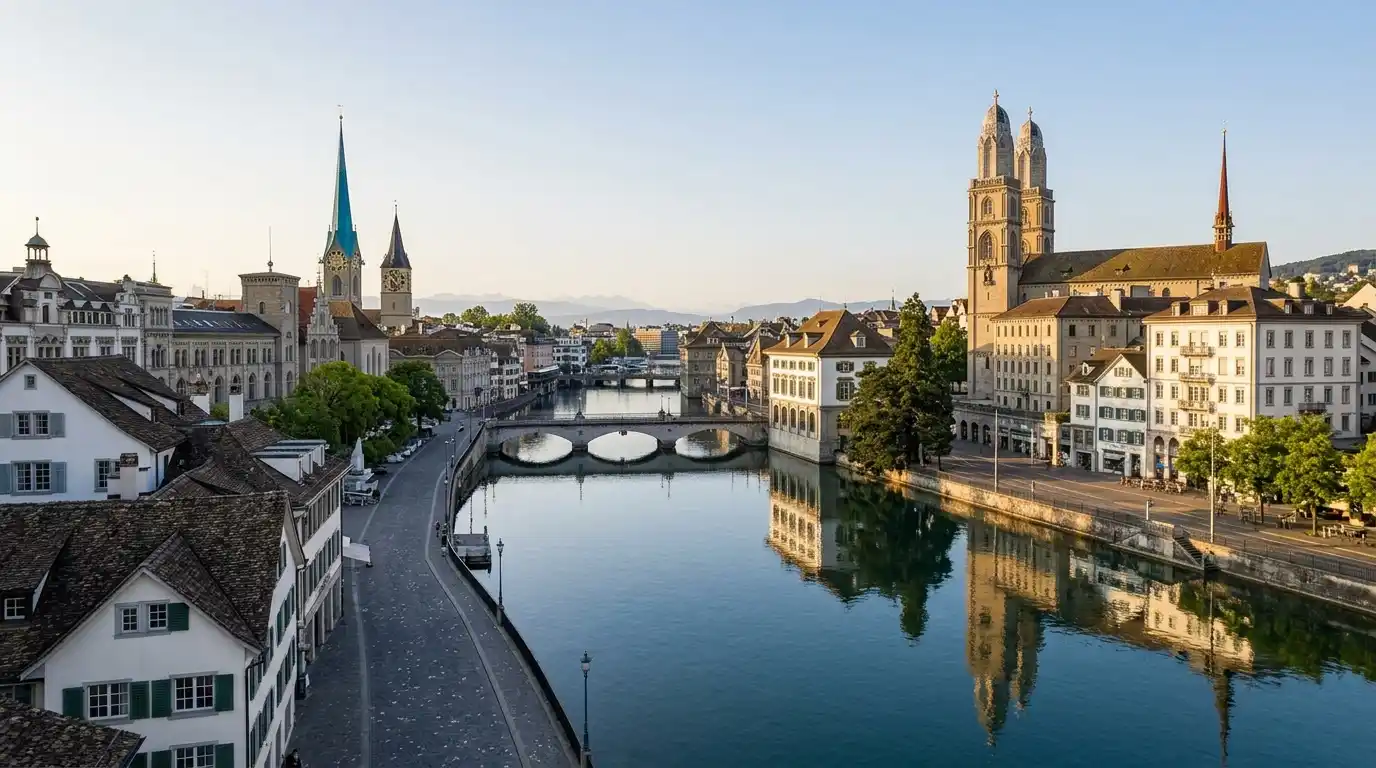
And then you walk out of the Hauptbahnhof and down toward the river and the old town opens up in front of you and the twin towers of the Grossmünster are reflected in the Limmat and there are people swimming in the river in the middle of the city and the cafés are full and the light on the lake at the end of the street is doing something that no photograph has ever fully captured.
And you realise that Zurich is not what you thought it was.
It is one of the most liveable cities in the world for reasons that have nothing to do with its banking system. It is beautiful in a quiet, unhurried way. It is a city that rewards slow exploration — the kind of place where getting slightly lost in the wrong direction consistently leads somewhere better than the place you were trying to reach.
It is also, for a city of its size, one of the most culturally rich in Europe. The museums are world-class. The food scene is serious and surprising. The lake and the river and the hills that rise behind the city create an outdoor life that most European capitals simply cannot offer.
This guide covers all of it.
Read more about: Things to Do in Manchester: The Complete Guide to Britain’s Most Exciting City
Before You Go: What to Know About Zurich
Zurich is Switzerland’s largest city but it is not a large city by the standards of most European capitals. It has a population of around 440,000 people in the city proper — smaller than many places that consider themselves mid-sized cities elsewhere in the world.
This scale is one of its greatest qualities. The old town is walkable in an afternoon. The lake is fifteen minutes from the main station on foot. The hills above the city — the Zürichberg and the Uetliberg — are reachable by public transport in under thirty minutes. The city does not sprawl. It concentrates itself.
Zurich is expensive. This is simply true and no amount of budget planning entirely removes it from the equation. Switzerland uses the Swiss Franc. Coffee costs more than you expect. Dinner costs considerably more. The museums, however, are frequently exceptional and occasionally free. The outdoor activities — swimming in the river, walking the hills, sitting in the parks — cost nothing at all.
The public transport system is one of the finest in the world. Trams run on time to the minute. The network covers the entire city and most of the surrounding region. Buy a day pass from a machine at the Hauptbahnhof and use it constantly.
Zurich rewards the visitor who moves slowly. The person who spends three days here sees more of the city than the person who spends one day trying to see everything. Plan fewer things. Stay longer in each one.
Read more about: Switzerland Summer Outfit Ideas for Women: The Complete Packing Guide
The Old Town — Altstadt
Walk the Niederdorf
The Niederdorf is the old town neighbourhood on the east bank of the Limmat and it is where Zurich reveals its medieval character most completely.
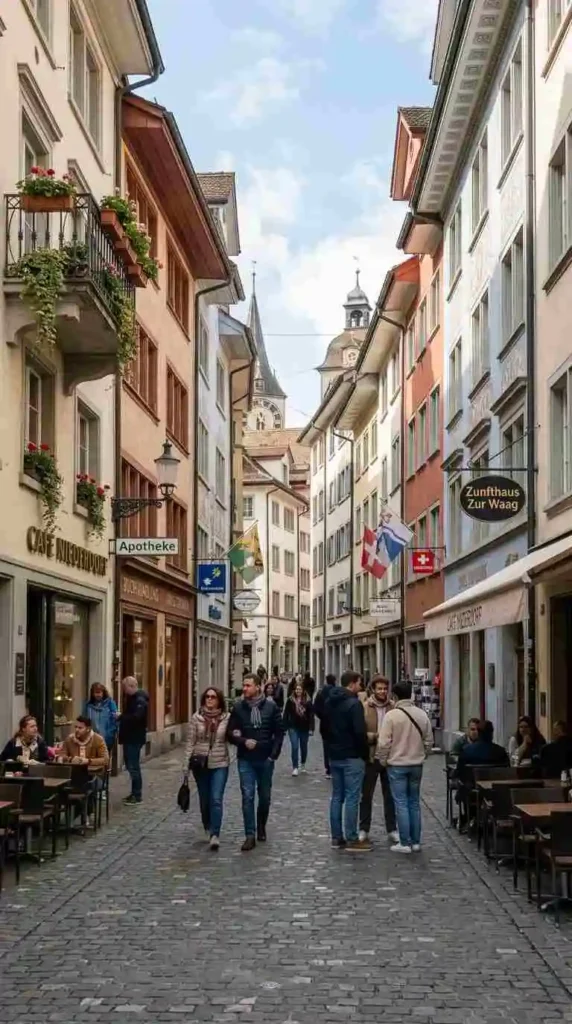
Narrow cobblestone lanes wind between guild houses that have stood in various forms since the twelfth century. Small squares appear unexpectedly between buildings. Fountain statues — the colourful medieval fountains that appear throughout the old town — mark the intersections of lanes too narrow for anything larger than a handcart.
Walk it without a specific destination. Start at the Münsterbrücke and move north through the streets, letting the lanes take you where they go. The Niederdorf is the part of Zurich that rewards the wandering approach most generously — every wrong turn leads somewhere interesting and getting lost here is a genuinely pleasant experience rather than a problem to be solved.
The neighbourhood is also where Zurich’s café culture concentrates most densely. Sit at a pavement table with a coffee. Watch the city move past. Stay long enough that the second coffee feels necessary.
Read more about: Things to Do in Spain: The Ultimate Travel Guide to an Unforgettable Trip
Explore the Left Bank — Lindenhügel
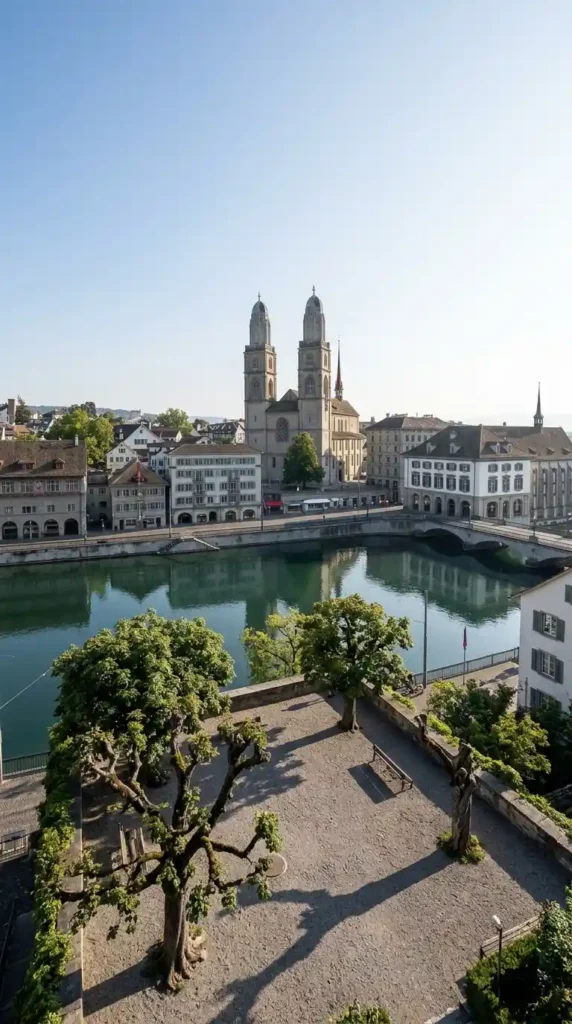
The west bank of the Limmat — the Lindenhügel, or linden hill — rises steeply from the river and holds the Lindenhof, a quiet hilltop terrace that was once the site of a Roman fort and is now the finest viewpoint in the city centre.
Climb to the Lindenhof through the steep lanes of the left bank old town. The view from the terrace — across the river to the Niederdorf and the church towers of the Grossmünster and the Wasserkirche, with the lake visible in the distance — is the Zurich view that visitors carry home in memory more reliably than any other.
The left bank old town is quieter than the Niederdorf and slightly more residential. The streets are steeper and the lanes narrower. The Guild House of the Meisen on the Münsterhof square below the Lindenhof is one of the finest Baroque buildings in the city.
Visit the Grossmünster
The Grossmünster — the Great Minster — is the cathedral whose twin towers define the Zurich skyline and whose history defines the religious and cultural character of the city.
It was here that Ulrich Zwingli launched the Swiss Reformation in 1519, making Zurich one of the founding centres of Protestant Christianity in Europe. The interior is deliberately spare — the reformers stripped the medieval decoration and left stone walls and clear glass windows and the particular quality of silence that very old, very plain churches hold.
Climb the Karlsturm — the southern tower — for the aerial view of the old town and the lake. The climb is 187 steps and the view from the top justifies every one of them.
The stained glass windows in the crypt were designed by Augusto Giacometti in 1932 and by Sigmar Polke in 2009 — two different centuries of Swiss art in glass, both extraordinary.
Read more about: Best Things to Do in Switzerland: The Complete Travel Guide
The Fraumünster and Its Chagall Windows
Across the river from the Grossmünster, on the west bank, the Fraumünster is the older and in one specific way the more remarkable of the two great Zurich churches.
Its five choir windows were designed by Marc Chagall between 1970 and 1978. The colours — the particular blue and the particular red that Chagall made his own across a career that spanned most of the twentieth century — are unlike anything else in Zurich and unlike almost anything else in any church in Europe.
Stand in the nave and look at the windows for long enough that the light through them changes. The Chagall windows are one of the genuinely great art experiences available in Switzerland and most visitors to Zurich do not know they are there.
Entry requires a small admission fee. It is worth it several times over.
Museums and Culture
The Kunsthaus Zurich
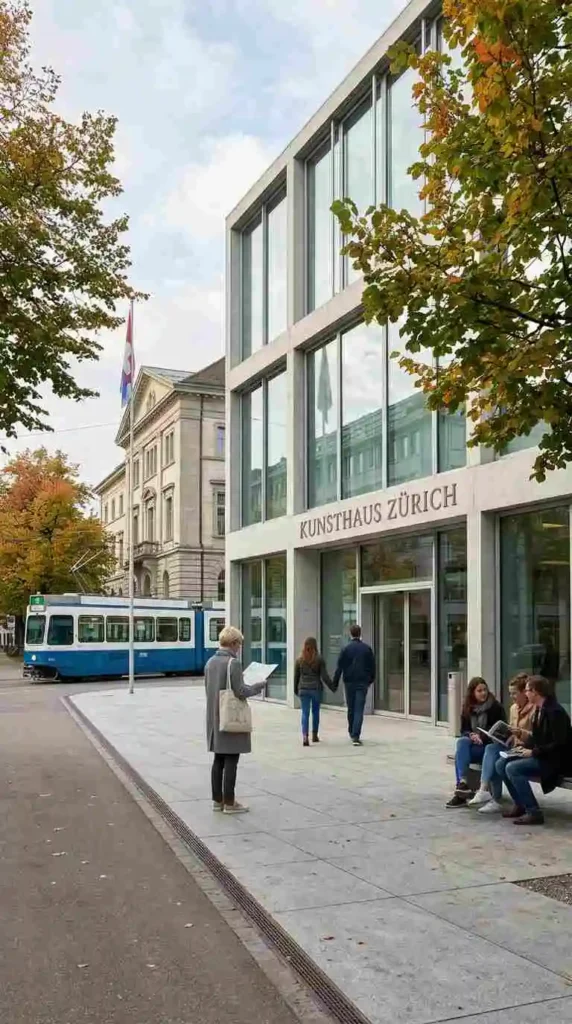
The Kunsthaus is one of the finest art museums in Europe and one of the most underestimated by visitors who come to Zurich primarily for other reasons.
Its permanent collection spans seven centuries and includes major works by Monet, Picasso, Munch, Kokoschka, and — most significantly — an extraordinary collection of Alberto Giacometti sculptures and works on paper that represents the largest single collection of the artist’s work anywhere in the world. Giacometti was Swiss and Zurich treats his legacy accordingly.
The museum expanded significantly in 2021 with a new building by David Chipperfield that doubled the exhibition space. The two buildings are connected by an underground passage and together constitute one of the most significant art museum complexes in central Europe.
Allow at least three hours. The Giacometti collection alone deserves one of them.
Read more about: Things to Do in Nashville: The Only Guide You Actually Need
The Swiss National Museum
The Landesmuseum — the Swiss National Museum — sits directly beside the Hauptbahnhof in a building that looks like a fairy-tale castle and contains the most comprehensive collection of Swiss cultural history in the country.
The permanent collection covers Swiss art, craft, and cultural life from prehistory to the present — armour, furniture, stained glass, textiles, clocks, paintings, and the extraordinary archaeological collection from Swiss lake dwellings of the Neolithic period that reveals a human presence on these lakeshores stretching back six thousand years.
The recently renovated exhibition spaces are beautifully designed and the castle building itself — a late-nineteenth-century historicist confection that somehow works — is worth exploring independently of the collection it contains.
Free entry on certain days. Worth the admission at any time.
The Museum Rietberg
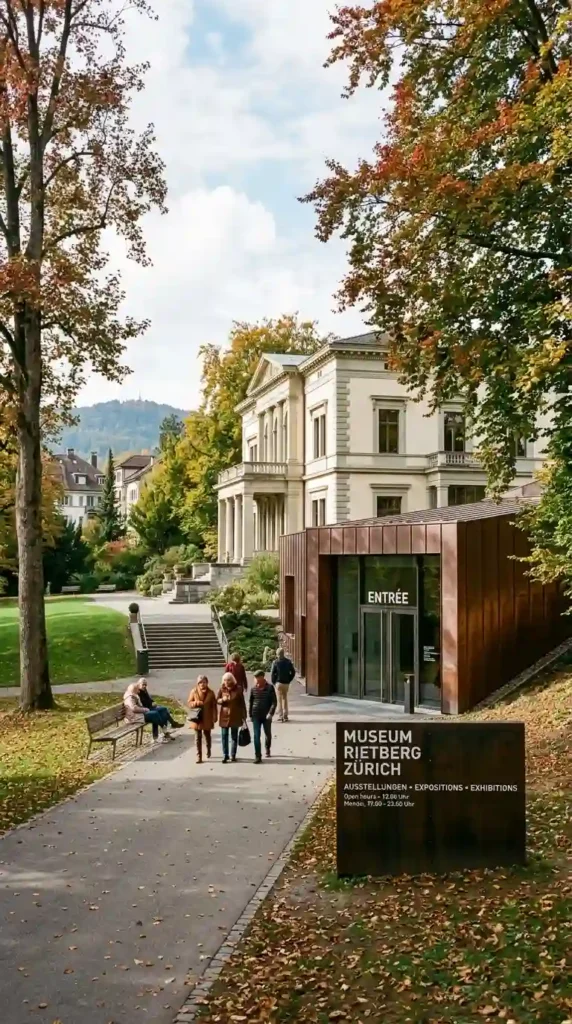
The Museum Rietberg in the Rieter Park above the lake is Zurich’s great ethnographic and non-European art museum and one of the finest of its kind in Europe.
Its collection covers Asian, African, and pre-Columbian art with a depth and seriousness that most Swiss visitors do not realise their city possesses. The Japanese, Chinese, and Indian collections are particularly significant. The building — partly underground, partly occupying two nineteenth-century villas in a landscaped park above the lake — is extraordinary.
The park alone is worth the journey on a warm day. The museum is worth it in any weather.
Read more about: Things to Do in Chicago: A Real Traveler’s Guide
The Cabaret Voltaire
A small museum and cultural venue on the Spiegelgasse in the Niederdorf occupies the premises of the original Cabaret Voltaire — the Zurich bar where Hugo Ball, Emmy Hennings, and a group of artists and writers founded the Dada movement in 1916.
Dada — the anti-art movement that responded to the absurdity of the First World War by embracing chaos, chance, and the dismantling of conventional aesthetic categories — was born in this room. Its influence on the entire subsequent century of art, literature, and culture cannot be overstated.
The venue is part museum, part active cultural programme. Visit the small permanent exhibition. Attend an evening event if the programme permits. Stand in the room where the most influential art movement of the twentieth century began and consider the improbability of it.
Lake Zurich
Walk the Lakefront Promenade
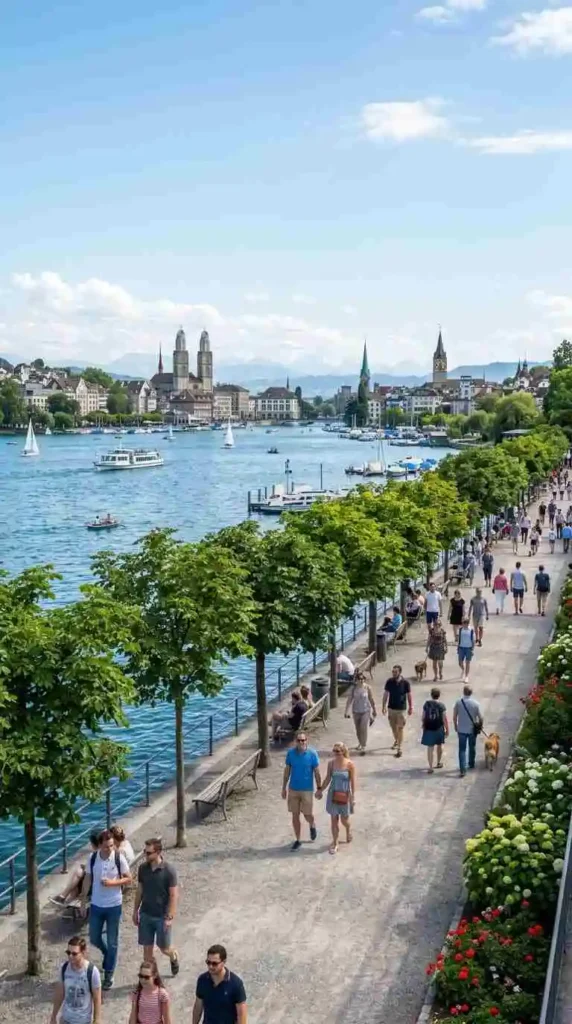
The lakefront promenade stretching south from the city centre along the western shore of Lake Zurich is one of the finest urban lakeside walks in Europe.
Flower gardens. Old villas and boathouses. The lake extending south toward the Alps, which appear on clear days as a white wall above the far end of the water. The Zürichhorn park at the northern end of the promenade with its sculptures and its café and its Chinese garden.
Walk it in either direction. Walk it at golden hour when the light on the water and the mountains is extraordinary. Walk it in the morning when the lake is still and the reflections are perfect. There is no bad time for this walk and no version of it that is not worth the time it takes.
Read more about: 6 Practical Travel Tips for a Worry-Free Solo Trip
Swim in the Lake
Swimming in Lake Zurich from the city’s public bathing areas — the Badis — is one of the essential Zurich summer experiences and one of the most surprising for visitors who have not been told about it.
The water is clean, cold, and an improbable shade of blue-green. The Badis — wooden platforms built over the water with changing facilities, diving boards, and a general atmosphere of uncomplicated summer pleasure — fill with locals throughout the summer months in a way that makes the lake feel like an extension of the city’s public life rather than a separate natural feature.
The Seebad Enge on the western shore and the Strandbad Mythenquai further south are the finest of the lake Badis. The Flussbad Oberer Letten on the Limmat river in the city centre is the river swimming option — faster, colder, and a slightly more urban experience.
Get in. The water is cold and perfect and this is what Zurich does in summer.
Take a Boat on the Lake
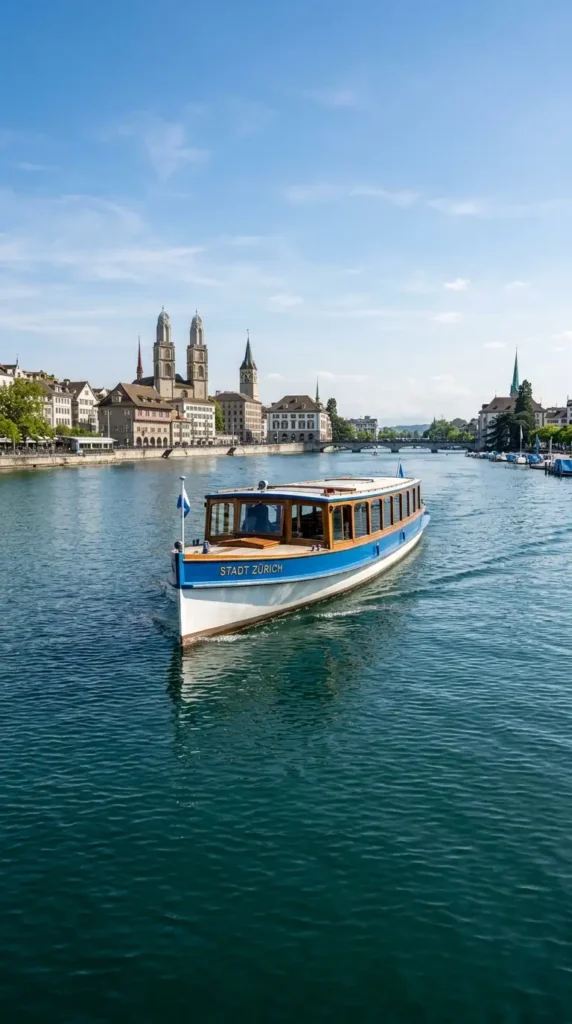
The paddle steamers and motor boats of the Zürichsee-Schifffahrtsgesellschaft have been operating on Lake Zurich since 1835 and remain the finest way to understand the lake and its relationship to the city and the Alps beyond.
A short circular cruise from the Bürkliplatz landing stage takes around an hour and passes the historic villas and boathouses of the western shore before crossing to the eastern bank and returning. A longer journey south toward Rapperswil — the rose city at the far end of the lake — takes two hours each way and passes through increasingly dramatic Alpine scenery.
Sit on the upper deck regardless of the weather. The view from the water back toward the city — the church towers, the hills, the old town clustered on the river banks — is the view that makes clear why people who visit Zurich for a weekend often end up living there.
Read more about: 25 Best Things to Do in Copenhagen: My Personal 2026 Travel Guide
Neighbourhoods
Zurich West — Kreis 4 and 5
Zurich West is where the city keeps its creative energy and it is the neighbourhood that surprises visitors who expect Zurich to be only the old town and the lake.
Former industrial buildings — the Zurich West district was the city’s manufacturing heart in the nineteenth and early twentieth centuries — converted into restaurants, bars, galleries, music venues, and cultural spaces. The Viadukt arches under the railway viaduct contain a covered market with independent food and fashion retailers. The Frau Gerolds Garten is a seasonal bar and garden built into a former industrial site that fills every warm evening with exactly the kind of crowd that makes a city feel alive.
The Langstrasse — the long street running through Kreis 4 — is the city’s most energetic evening destination. Bars and restaurants at street level, a demographic range that covers everything from neighbourhood regulars to international visitors, and a general atmosphere of the city at its most relaxed and most itself.
The Hürlimann Areal
The former Hürlimann brewery in Kreis 3 — south of the centre on the western side of the river — has been converted into a complex of hotels, restaurants, a thermal spa, and cultural spaces that represent the most successful adaptive reuse project in the city.
The Thermalbad & Spa Zürich uses the original brewery tanks and cellars as the structure for a thermal bathing experience that is simultaneously industrial archaeology and luxury wellness. The roof pool — an outdoor circular pool on top of what was once a brewery vat — offers a view across the Zurich skyline that is unlike any other in the city.
Book in advance. The rooftop pool in particular fills quickly.
Read more about: 10 Best Things to Do in Cinque Terre: A Colorful Italy Guide
Seefeld
The Seefeld quarter east of the city centre — between the lake and the Zürichberg hill — is the neighbourhood that makes the case for Zurich as a place to live rather than merely a place to visit.
Quiet residential streets lined with nineteenth-century apartment buildings. Independent cafés and restaurants that serve primarily the neighbourhood rather than tourists. The Zürichhorn park with its lakeside lawns and its sculpture garden. The Heidi Weber Pavilion — the only building Le Corbusier designed as a museum — sitting beside the lake in a building that looks like a spacecraft and contains an extraordinary collection of Le Corbusier’s paintings, furniture, and architectural models.
Walk through Seefeld on a Sunday morning. Buy something from one of the small food shops. Sit in the park beside the lake. Understand why Zurich consistently appears at the top of global quality-of-life surveys.
Day Trips from Zurich
The Uetliberg
The Uetliberg — the hill that rises directly above Zurich to the southwest — is the city’s mountain. At 871 metres it is modest by Swiss standards but its accessibility makes it the outdoor experience that Zurich residents use most consistently.
A direct train from the Hauptbahnhof reaches the summit station in twenty minutes. From there a short walk reaches the observation tower and the panoramic view across the city, the lake, and on clear days the full arc of the Alps from the Säntis in the east to the Bernese Alps in the southwest.
Walk back down through the forest rather than taking the return train. The descent through the woods above the city — on marked trails that vary from easy to moderate — takes between one and two hours depending on the route and is one of the finest things you can do in a day in the Zurich region.
Read more about: 8 Best Things to Do in Florence: The Ultimate Travel Itinerary
Rhine Falls at Schaffhausen
An hour by train from Zurich, the Rhine Falls near Schaffhausen is the largest waterfall in Europe by volume and one of the most dramatic natural experiences in Switzerland.
Standing on the rocks in the middle of the falls — accessible by small boat from the southern shore — with the full force of the Rhine thundering past on every side is a visceral experience that photographs cannot prepare you for. Visit in early summer when snowmelt from the Alps swells the river to its maximum.
The town of Schaffhausen above the falls is worth two hours of exploration independently — the Munot fortress above the old town, the painted facades of the Ritter house, the old town streets that have changed less in five hundred years than most European towns have changed in fifty.
Lucerne
An hour by train from Zurich, Lucerne is the Swiss city that most completely delivers on the promise of what visitors imagine Switzerland to be.
The Chapel Bridge. Lake Lucerne and its surrounding mountains. The Lion Monument. The old town with its painted facades and its covered bridges and its medieval fountains.
Lucerne is covered in full elsewhere in this guide series. Go for a day. Consider staying longer.
Read more about: 10 Beautiful Towns in Italy for Your Next Travel Itinerary
Food and Drink in Zurich
The Zurich Food Scene
Zurich’s food scene has developed significantly in the past decade and the city now has a restaurant culture that surprises visitors who expect Swiss food to begin and end with fondue and raclette.
Both of those things exist and both are worth eating. Fondue in winter — a communal pot of melted Gruyère and Vacherin with bread for dipping — is one of the most socially pleasurable meals available in this country. Raclette — melted cheese scraped over potatoes, pickles, and onions — is simpler and equally satisfying.
Beyond the classics: Zurich Geschnetzeltes is the local speciality — strips of veal in a cream and mushroom sauce served with Rösti, the Swiss potato cake. It appears on almost every traditional restaurant menu in the city and is worth ordering at least once.
The restaurant concentration in the Niederdorf, Zurich West, and the Seefeld neighbourhood covers everything from neighbourhood bistros to serious destination restaurants. The covered market under the Viadukt arches in Zurich West is the best single location for food shopping and casual eating.
Coffee in Zurich
Zurich takes coffee seriously in a way that pleasantly surprises visitors who associate Switzerland primarily with chocolate and watches.
The third-wave coffee culture that arrived in the city in the early 2010s has matured into a scene of serious independent cafés concentrated primarily in Zurich West, the Kreis 4 and 5 neighbourhoods, and scattered through the Niederdorf.
Eat coffee with a Gipfeli — the Swiss croissant, slightly less buttery than the French version, slightly more robust — in the morning at a good café and the day begins correctly.
Zurich’s Market Culture
The Bürkliplatz flea market on the lakefront — running every Saturday morning from May to October — is one of the finest outdoor markets in Switzerland. Antiques, vintage clothing, furniture, books, and the particular mix of genuine finds and optimistic pricing that characterises every good flea market in Europe.
The Farmers’ Market at the Helvetiaplatz in Kreis 4 runs on Tuesdays and Fridays and is where the city’s serious food buyers go for produce, cheese, bread, and the seasonal ingredients that the Zurich restaurant scene depends on.
Read more about: 10 Best Things to Do in Chamonix, France: The Perfect Adventure Itinerary
Practical Tips for Visiting Zurich
The ZVV day pass covers all public transport in the city and surrounding canton — trams, buses, the S-Bahn, and the lake boats. Buy it at the Hauptbahnhof on arrival. It pays for itself within the first few journeys.
The Swiss Travel Pass covers Zurich transport as part of a broader Swiss travel package. If Zurich is one stop on a longer Switzerland trip, the Travel Pass is the more economical option.
Most museums in Zurich are free on the first Sunday of the month. Time your visit accordingly if the museum budget is a consideration.
The lake swimming Badis are free or very low cost. They require only a small changing fee at most locations. Bring a towel and a swimming costume and use them.
Zurich is very safe. The level of general public safety — at night, in any neighbourhood, at any time — is among the highest of any European city. Walk freely and without the heightened awareness that some cities require.
Sunday in Zurich is quiet. Shops close. The city slows. Plan practical errands and shopping for weekdays. Plan lake walks, museum visits, and long café afternoons for Sunday. The city on Sunday is a different and in some ways better version of itself.
The Best Time to Visit Zurich
Every season in Zurich offers something genuinely different.
Summer (June to August) is the peak season and the finest weather. The lake is warm enough to swim. The outdoor Badis are open. The Zürichhorn park fills with people. The restaurant terraces are packed into the evening. Book accommodation well in advance.
Spring (April to May) brings the city out of its winter reserve. The chestnut trees along the lake promenade come into flower. The outdoor café season begins tentatively and then fully. The crowds have not yet arrived. The light is extraordinary.
Autumn (September to October) is the season that many experienced Zurich visitors prefer. The city returns to itself after the summer tourist peak. The light is golden and lower. The lake is still warm enough to swim in September. The restaurant scene reaches its annual peak as the summer tourists leave and the local food culture reasserts itself.
Winter (November to March) transforms Zurich into a city of markets, fondue, and the particular warmth that Swiss cities generate in cold weather. The Christmas market at the Hauptbahnhof is among the finest in Europe. The Zurich Film Festival in late September and the Street Parade techno festival in August are the two cultural events that define the city’s annual calendar.
Read more about: France Travel Itinerary: The Ultimate 10-Day Route
Final Thoughts
Zurich rewards the visitor who arrives with lower expectations and leaves with higher ones than any city in Europe they have visited.
It is not a city that announces itself. It does not have the immediate drama of Barcelona or the overwhelming beauty of Rome or the sheer scale of London or Paris. It has something quieter and more lasting — a combination of exceptional quality of life, genuine cultural depth, natural beauty of a kind that most cities cannot offer, and a character that reveals itself slowly and consistently to anyone who takes the time to look.
The people who visit Zurich for a weekend and book a return trip before they leave are not unusual. They are the predictable outcome of a city that gives more than it promises.
Take your time here. Walk slowly through the old town. Swim in the lake if the season allows. Sit on the Lindenhof in the afternoon and look across the river. Find a café in the Niederdorf and stay until the light changes.
Zurich is not trying to impress you. That is exactly why it does.
Go slowly. Look carefully. Zurich rewards the patient visitor more than you will expect.