Spain Summer Outfit Ideas: What to Actually Wear in the Most Vibrant Country in Europe

There is a moment that happens to almost every woman who arrives in Spain in summer for the first time.
You step out of the airport or the train station and the heat hits you immediately — not the polite warmth of a northern European summer but a serious, physical, all-encompassing heat that tells you without ambiguity that you are somewhere different. The light is brighter here. The shadows are sharper. The colours of everything around you — the terracotta, the whitewash, the deep blue of the sky above Seville or Barcelona or Granada — are more saturated than the photographs prepared you for.
And somewhere in that first hour you look at what you packed and you start making calculations.
Spain in summer is not one country and not one climate. Barcelona on the Mediterranean coast is different from Seville in the inland Andalusian heat. San Sebastián in the Basque Country on the Atlantic coast is different from both. The white villages of the Costa de la Luz are different from the resort towns of the Costa del Sol. Madrid in July — sitting on a high plateau at 650 metres — is different from anywhere on the coast.
This guide is the practical version of dressing correctly for all of it.
Thirteen outfit ideas for Spain in summer — for the cities and the coasts, for the tapas bars and the beach clubs, for the late Spanish dinners and the long hot afternoons — that look exactly right for the most vibrant country in Europe.
Read more about: FIFA World Cup Outfits for Women: The Complete Style Guide for Every Match Day
Before You Pack: What Spain Actually Needs from Your Wardrobe
Spain in summer is the most physically demanding climate in Western Europe for dressing.
Seville in July and August is the hottest city in continental Europe — temperatures regularly exceed 40 degrees Celsius and the advice from every Spanish person who has lived there is simply: stay inside between noon and five and wear as little as decency and the dress code require outside those hours.
Barcelona is more temperate — the Mediterranean modulates the heat and the sea breeze off the Barceloneta makes the city more liveable than the inland alternatives. But Barcelona in July still reaches 30 degrees regularly and the city’s packed summer tourist season means crowds, movement, and the heat that crowds generate.
Madrid sits at altitude and this changes its summer character significantly. The days are hot — 35 to 38 degrees in July — but the evenings cool dramatically because of the elevation. A Madrid summer evening at ten o’clock, when Spaniards are just beginning to think about dinner, can be genuinely cool. The layer that is entirely unnecessary at noon is welcome by midnight.
The Basque Country — San Sebastián, Bilbao — is the coolest Spanish summer destination. Atlantic exposure, green hills, and a climate that is more like southwest France than Andalusia. Summer here requires the lightest version of the layer that northern European summer demands.
The Spain summer packing principles:
Fabric above everything. Linen and cotton are not a preference in Spanish summer. They are a requirement. Anything synthetic becomes unwearable in serious heat.
Coverage for churches and historic sites. Spain’s extraordinary religious and cultural architecture — the Alhambra, the Sagrada Família, the Cathedral of Seville — requires covered shoulders and appropriate lengths at many sites.
Shoes that survive Spanish terrain. The old towns of Toledo, Granada’s Albaicín, Barcelona’s Gothic Quarter — all of them are cobblestone and all of them are uneven. The right shoes make the difference between a beautiful day and a painful one.
The layer for Madrid and Basque Country evenings. The dramatic temperature drop of the Madrid night and the Atlantic cool of the north require something to put on when the day heat disappears.
And Spanish colour. Spain is the European country that wears colour most confidently and the wardrobe that responds to that confidence photographs better here than anywhere else in Europe.
Read more about: Portugal Outfit Ideas: What to Actually Wear in One of Europe’s Most Beautiful Countries
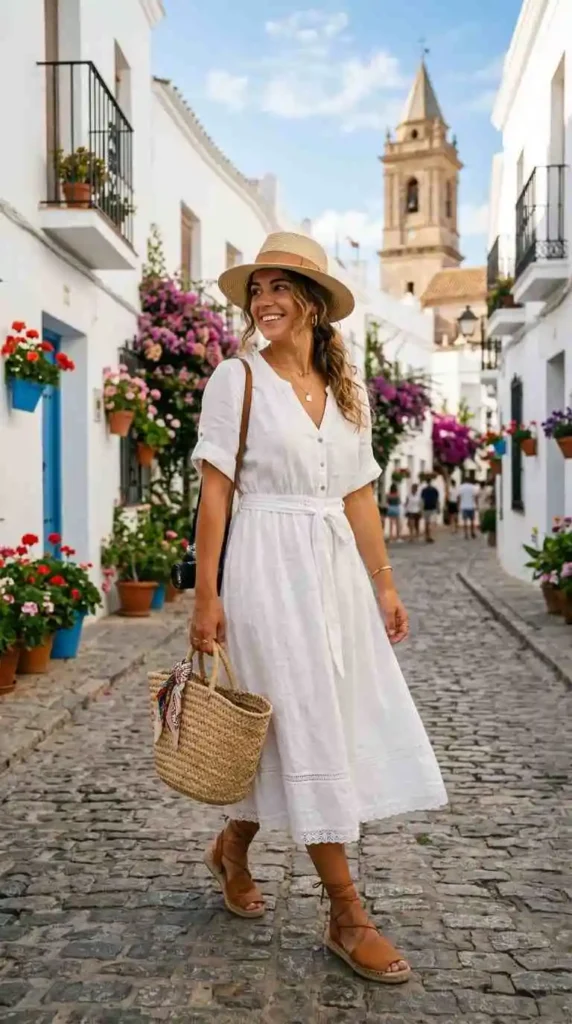
01. The White Linen Dress for Andalusia
Andalusia — Seville, Córdoba, Granada — is the Spain that requires the most radical adjustment in dressing from the European norm.
The heat here in July and August is not the heat of a warm summer day in Paris or Rome. It is a different category of temperature entirely — the kind that requires rethinking what you are wearing before you leave the accommodation and accepting that comfort is not a secondary consideration but the primary one.
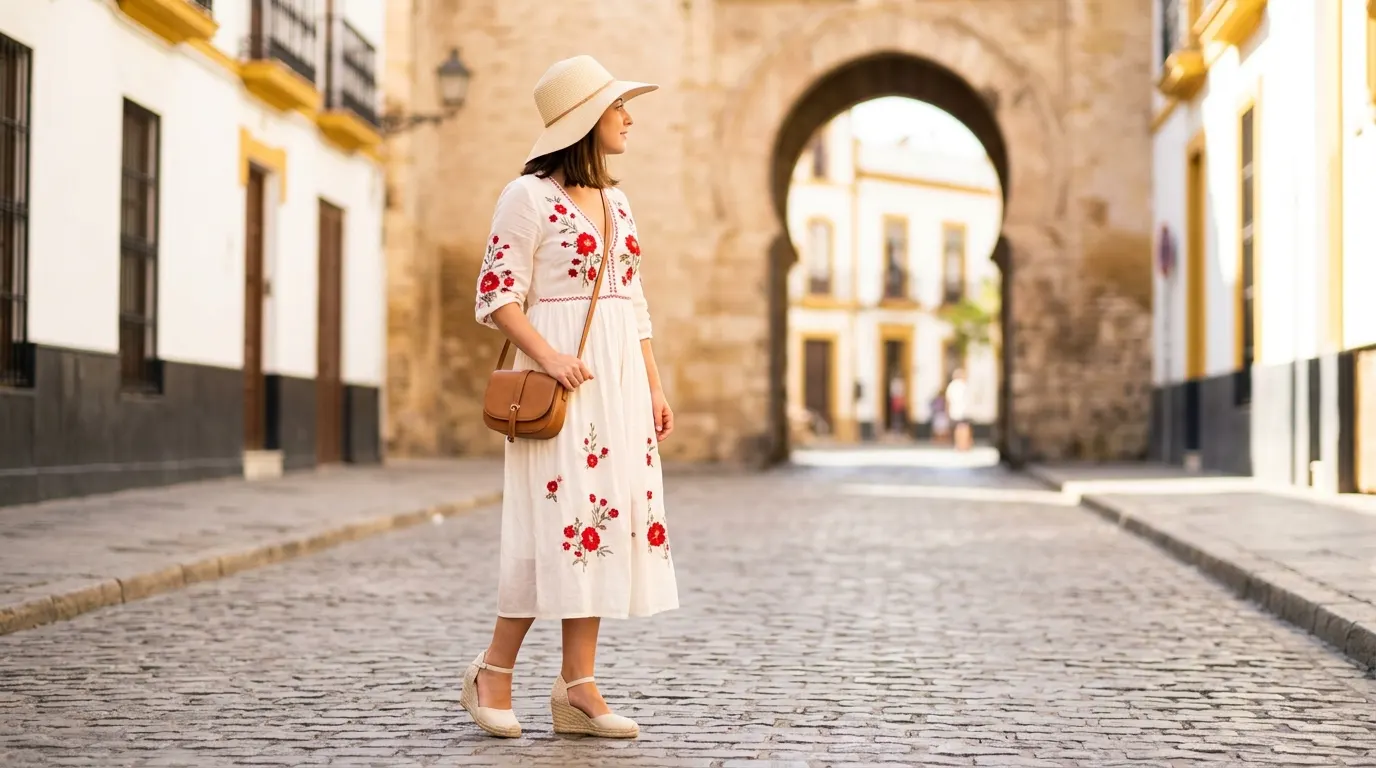
A white or off-white linen dress — loose, breathable, midi length — is the Andalusia summer outfit that handles the heat most completely. White reflects rather than absorbs heat. Linen breathes in a way that no other fabric manages at these temperatures. Midi length satisfies the coverage requirements of the Alhambra and the Cathedral of Seville without requiring a separate layer.
Flat leather sandals — broken in completely before the trip. A woven or straw bag. A wide-brimmed hat for the outdoor sections of the day. Sunglasses. That is the complete Andalusia summer outfit.
Add nothing. Remove nothing. In 40-degree heat the white linen dress worn with flat sandals and a hat is not a style choice. It is the correct response to the environment.
02. The Barcelona Beach Club Outfit
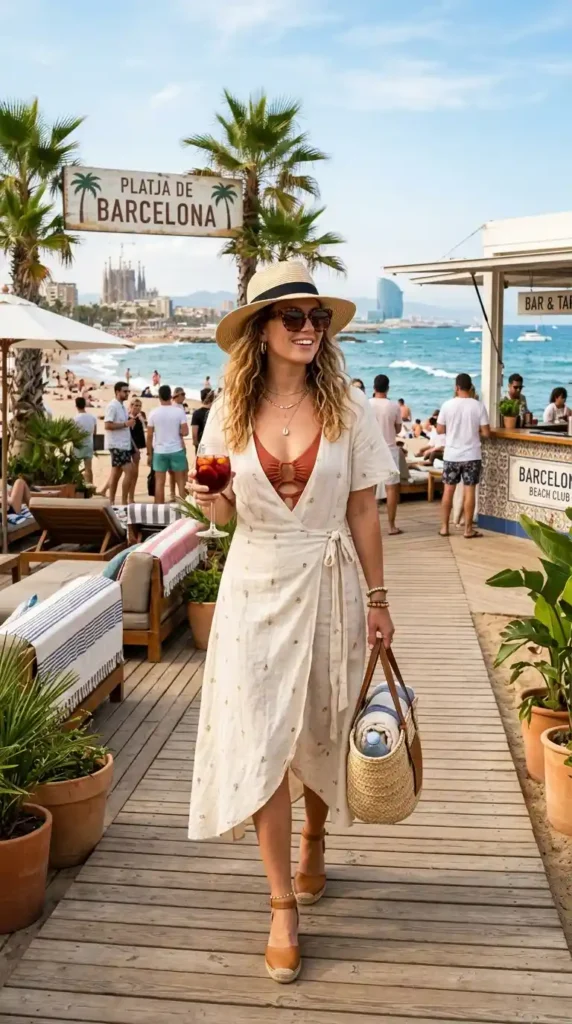
Barcelona’s coastline — the Barceloneta beach, the beach clubs of the Poblenou waterfront, the open-air restaurants and bars that line the sea — requires an outfit that converts between beach and social context without a full change.
A quality swimsuit or bikini in a colour that works for the wearer — the Barcelona beach is stylish and the swimwear here is considered rather than casual — with a lightweight cover-up that also walks into the beach club restaurant and the waterfront bar. The linen shirt dress. The oversized linen shirt. The silk slip worn over the swimsuit.
The cover-up is the critical piece in this context. Barcelona’s beach clubs have a dress code that is more than a swimsuit once you step off the sand. The cover-up that converts from beach to restaurant is the piece that handles the full Barcelona coast day without requiring a wardrobe change.
Flat leather sandals or espadrilles — the canvas and rope shoe of the Spanish Mediterranean coast, made here since the nineteenth century. A woven bag large enough for beach essentials and the cover-up when it is not being worn. A hat for the midday sun on the beach.
03. The Red Outfit for Spain
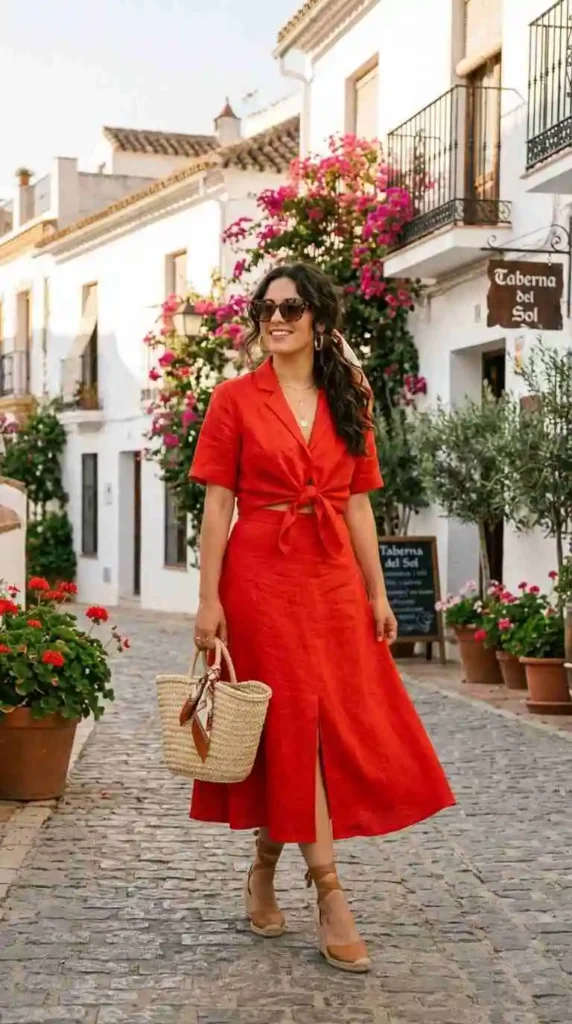
Red in Spain is not a tourist move. It is a response to the country.
The red of the Spanish flag, the red of the flamenco dress, the red of the terracotta rooftops and the dried peppers hanging in the market stalls of every Andalusian town — red is Spain’s colour in a way that is specific and historical and visible everywhere you look in the country.
A red linen dress — simple, midi, flat sandals. Or wide-leg red linen trousers with a white top. Or a red co-ord in a quality summer fabric. In any form, red in Spain photographs against the whitewashed walls of Andalusia, the Gothic stone of Barcelona, and the warm terracotta of Madrid’s architecture with a rightness that is immediately apparent.
The red outfit in Spain is not the red outfit in England or Germany. The light is different. The architecture is different. The entire visual context of the country amplifies red in a way that makes the same colour look more itself here than anywhere else.
Wear it simply. A red dress with flat sandals and nothing else needs nothing added. Spain and the red dress understand each other without translation.
Read more about: 2026 Summer Fashion Trends: The Complete Guide to What Is Actually Worth Wearing
04. The Madrid Evening Outfit
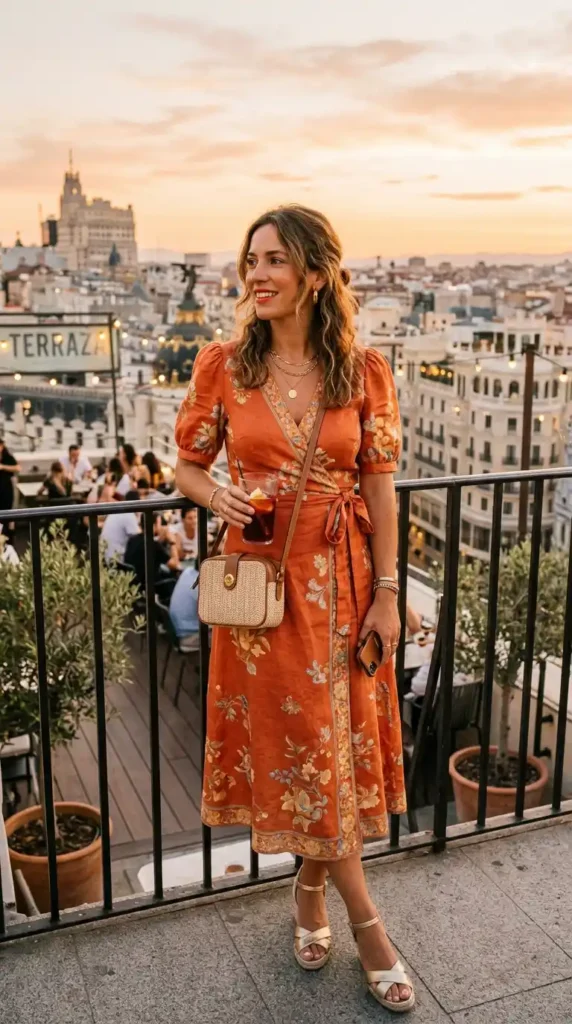
Madrid is the city that takes evening dressing most seriously in Spain.
Dinner in Madrid does not begin before nine. Often ten. The streets in the Malasaña and Chueca neighbourhoods, the rooftop bars above the Gran Vía, the traditional restaurants of the Barrio de las Letras — all of them fill from nine onwards with Spaniards who have dressed for the evening with the particular care that the city brings to its nightlife.
Madrid in July cools dramatically after sunset. The same city that required a white linen dress at noon is cooler by midnight than any seaside destination in Spain. The Madrid evening outfit needs to handle that temperature shift.
A silk midi dress in a deep jewel tone — cobalt, emerald, warm burgundy — with leather heeled sandals or pointed-toe mules. A lightweight blazer or linen jacket that goes into the bag when the restaurant is warm and comes out when the street is cool. A structured small bag. Gold jewellery.
This is the outfit for the late Madrid dinner that extends to midnight and becomes a spontaneous walk through the Retiro in the warm dark. The outfit that reads as dressed without reading as formal in a city that does not do formal but does do well-dressed at every hour.
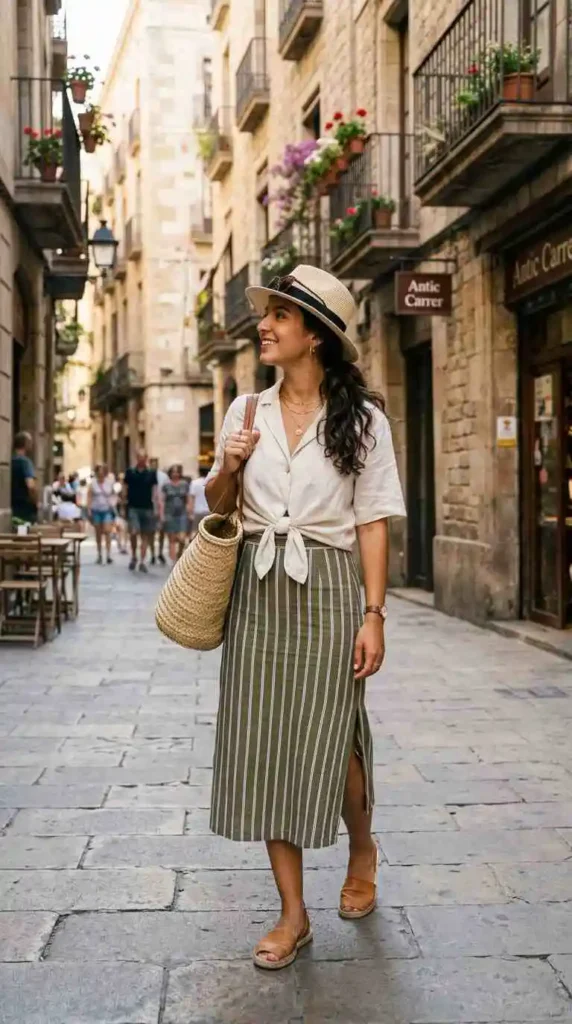
05. The Barcelona Gothic Quarter Exploration Outfit
The Gothic Quarter — the Barri Gòtic — is the medieval heart of Barcelona and one of the most concentrated areas of extraordinary architecture in Europe. The Roman walls, the medieval streets, the Cathedral of Barcelona rising above the narrow lanes — all of it is best explored on foot at a pace that allows the detail to be seen.
The Gothic Quarter exploration outfit: comfortable leather trainers or flat leather sandals in a clean colourway. Wide-leg linen trousers or a midi skirt that moves freely. A simple fitted top or linen tank. A crossbody bag that stays on the shoulder without requiring hands. A lightweight scarf for the Cathedral.
The light in the Gothic Quarter is specific — the narrow lanes create deep shadow and the patches of direct sunlight between buildings create contrast that photographs beautifully. An outfit in a light colour — cream, white, pale sage — catches the Barcelona light in those patches in a way that darker colours do not.
This is not the outfit for the beach or the rooftop bar. It is the outfit for the hours of slow walking through old stone that produce the most lasting memories of any Barcelona trip.
Read more about: Party Outfit Ideas: The Complete Style Guide for Every Occasion
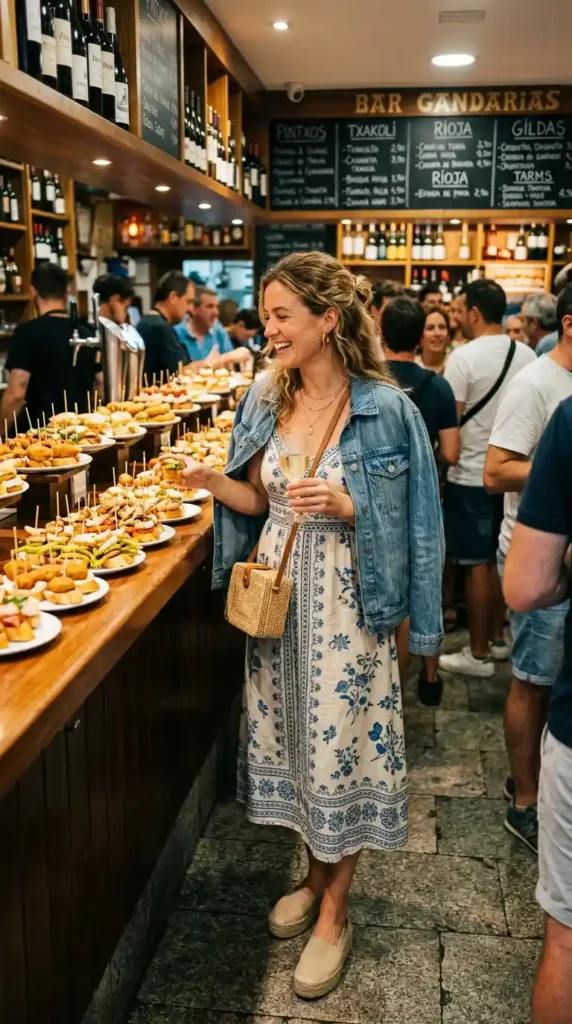
06. The San Sebastián Pintxos Bar Outfit
San Sebastián — the Basque coastal city that holds more Michelin stars per capita than almost any other city in the world — is the Spanish food destination and it has a dress code that reflects its culinary seriousness.
The pintxos bars of the Parte Vieja — the old town — are the social and cultural institution of San Sebastián. From seven in the evening they fill with locals moving between bars, ordering wine and the small bites that line every bar top, standing at the bar in the way that San Sebastián specifically stands at bars.
The San Sebastián outfit: more covered than the Andalusian heat requires. A light linen or cotton midi dress with leather sandals or loafers. Or wide-leg linen trousers with a well-cut fitted top. A blazer or linen jacket for the Atlantic evening that is cooler than any Mediterranean destination equivalent.
San Sebastián is elegant without being formal. The food is serious and the dressing that accompanies it should be serious without going beyond what the relaxed Basque culture expects. A good outfit, well-fitted, in a quality fabric — that is the San Sebastián standard and it is not a difficult one to meet.
07. The Flamenco-Inspired Outfit
Flamenco is not a costume and the woman who dresses for a flamenco show in Seville or Granada in a full ruffled dress and castanets is dressing for a theme night rather than for the country.
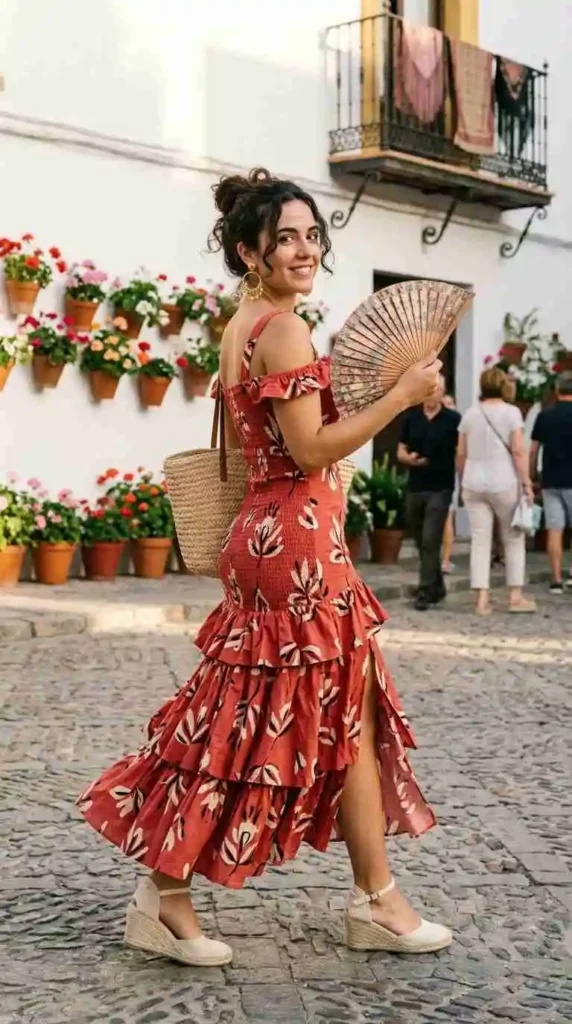
The flamenco-inspired outfit is different. It takes the vocabulary of flamenco dress — the polka dot print, the ruffled hem detail, the high-waisted silhouette, the bold colour — and wears those elements as fashion rather than as performance costume.
A polka dot midi dress in a bold ground colour — black with white dots, red with black dots, deep cobalt with cream dots — is the flamenco print worn as travel fashion rather than flamenco outfit. With flat leather sandals, a woven bag, and gold jewellery, it reads as Spain-specific in the most direct and honest way: as the fashion of a country worn by someone who has paid attention to where they are.
The ruffled hem detail — on a skirt, on the sleeve of a dress — is the flamenco vocabulary element that transfers most directly into contemporary fashion. A midi dress or skirt with a tiered ruffle hem in a bold Spanish colour is the flamenco reference that does not require explaining.
Read more about: Europe Vacation Outfit Ideas: The Complete Style Guide for Every Destination
08. The Costa del Sol Beach Outfit
The Costa del Sol — Málaga, Marbella, Torremolinos, Nerja — is the Spanish coast that has been attracting summer visitors since the 1960s and the beach outfit that works here is the beach outfit that has also been working since the 1960s: good swimwear, a good cover-up, and the confidence to wear both correctly.
A quality bikini or swimsuit in a colour that works for the wearer. A cover-up that is also a fashion piece — the linen shirt dress, the oversized button-down, the slip dress over the swimsuit. Flat sandals or espadrilles. A large woven bag. A hat that is large enough to be useful.
The Costa del Sol beach club scene — particularly in Marbella, which runs one of the most style-conscious beach club scenes in Europe — rewards dressing up for the beach in a way that most beach destinations do not. The cover-up here is not an afterthought but a deliberate part of the beach outfit. The swimwear and the cover-up are both chosen with the same care.

09. The Granada Alhambra Visit Outfit
The Alhambra in Granada is the most visited monument in Spain and one of the most extraordinary examples of Islamic architecture anywhere in the world. A visit to the Alhambra is a full day — the palace complex is vast, the walking is significant, and the queues even with a timed ticket require patience.
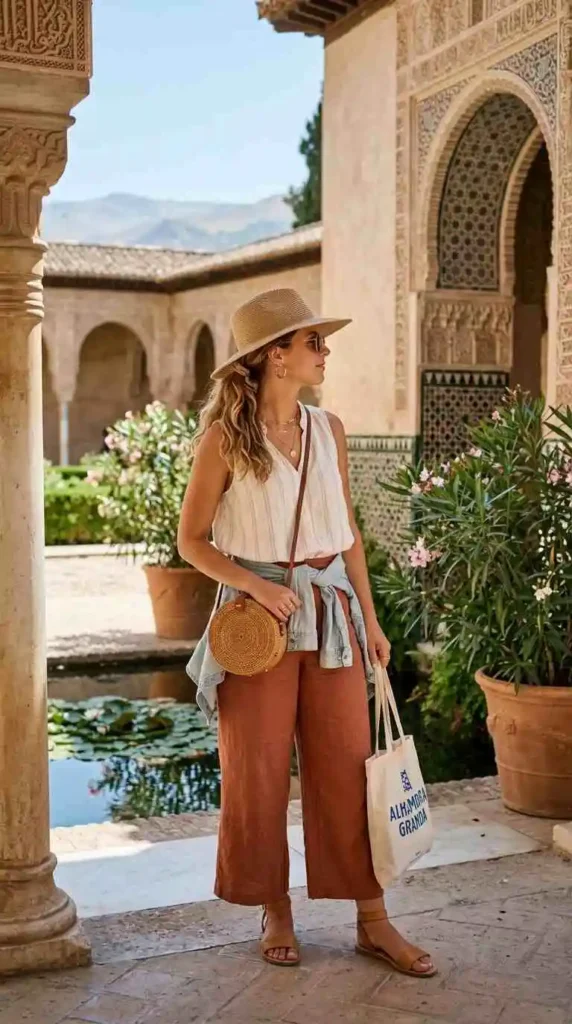
The Alhambra outfit is the most practically constrained outfit in this guide. It needs to be comfortable for a full day of walking on uneven stone. It needs to cover the shoulders and the knees for the religious sites within the complex. It needs to handle the heat of the Granada July — significantly more intense than Barcelona or Madrid.
Wide-leg linen trousers in a neutral with a simple fitted top that covers the shoulders. Or a midi linen dress that satisfies all coverage requirements without a separate layer. Flat shoes with genuine grip — the stone paths of the Alhambra are worn smooth and can be slippery. A crossbody bag. A hat.
The Generalife gardens — the extraordinary terraced gardens of the Alhambra — are the most photographed section of the complex and the outfit that photographs best against them is the one in a warm neutral that responds to the terracotta and water and green of the garden rather than competing with it.
Read more about: College Outfit Ideas for Girls: The Complete Style Guide for Every Day on Campus
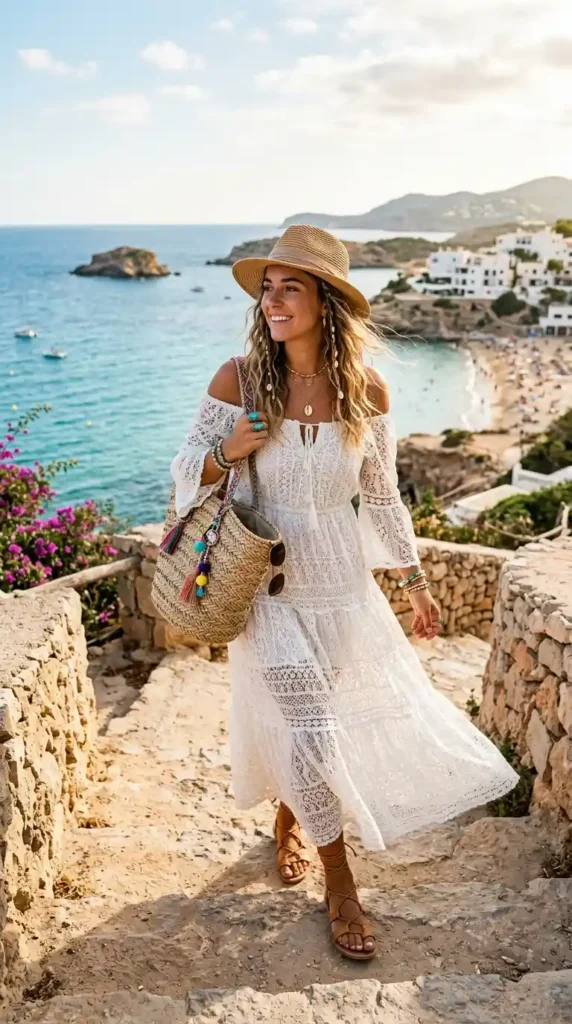
10. The Ibiza Summer Outfit
Ibiza is a specific version of Spain that requires a specific version of the Spain summer wardrobe.
The daytime Ibiza outfit — the beach clubs, the market at Las Dalias, the old town of Dalt Vila — is relaxed and creative. The island’s fashion culture rewards individual expression over conventional summer dressing. Crochet. Tie-dye. Bold print. Layers of gold jewellery. The handcraft aesthetic that has been part of Ibiza’s identity since the bohemian arrivals of the 1960s.
A crochet top with wide-leg linen trousers and leather sandals for the morning market. A tie-dye maxi dress for the beach. A simple linen dress with maximum gold jewellery for the afternoon restaurant with a sea view.
The Ibiza evening — the sunset at Café del Mar, the open-air venues that the island invented and that the rest of the world has been copying for forty years — requires the most considered outfit of the Spanish summer wardrobe. A silk slip dress or a deliberately elegant version of the bohemian daytime outfit — more refined, more specifically evening, wearing the same aesthetic at a higher register.
11. The Linen Co-ord for Spanish Cities
The matching linen co-ord — wide-leg trouser and oversized shirt in the same fabric and colour — is the Spanish city outfit that reads as the most intentional and requires the fewest decisions.
In a warm terracotta, a dusty sage, a warm cream, or the natural linen colour itself, the co-ord works across every Spanish city context from morning exploration to afternoon museum to evening tapas. The pieces together create the co-ord effect. Separated they create additional outfits.
Spain’s cities are walkers’ cities — the old towns, the market streets, the cathedral quarters and the contemporary neighbourhoods that coexist in every Spanish city require significant walking and the linen co-ord handles all of it while remaining comfortable in Spanish summer heat.
Wear with flat leather sandals and a crossbody bag for the daytime version. With leather loafers and a structured bag for the smart casual version. With leather mules for the evening version when the temperature has dropped enough to make the longer trouser comfortable.
12. The Spanish Coast Sundress
The Spanish coast — the entire arc of it, from the Costa Verde in the north to the Costa del Sol in the south, from the Costa Brava above Barcelona to the Costa de la Luz in the southwest — is the summer destination that earns the most uncomplicated version of summer dressing.
A lightweight sundress in a summer colour — warm coral, cobalt blue, sunny yellow, warm white — with flat leather sandals or espadrilles and a woven bag. Nothing more is required and nothing more should be added.
The Spanish coast sundress is the outfit that is most completely itself in its setting. The colour against the blue of the Mediterranean or the Atlantic. The lightweight fabric moving in the coastal breeze. The flat sandal on the boardwalk between the beach and the café.
This is not the outfit for the Alhambra or the Sagrada Família. It is the outfit for the days when the only agenda is the beach in the morning, the seafood lunch at noon, the afternoon walk along the promenade, and the sunset aperitivo at the bar with the best view of the water.
Those days exist on the Spanish coast in summer. Dress for them without apology.
Read more about: Paris Travel Outfits: What to Actually Wear in the Most Stylish City in the World
13. The Final Spain Evening — Tapas and Wine and the Long Spanish Night
Spain’s evening culture is unlike any other country in Europe.
Tapas begin at eight. Dinner at ten. The streets are full until two in the morning on a Tuesday in July. The Spanish night is long and warm and social in a way that northern European evening culture is not and has never been. The final evening of a Spain trip — the last dinner, the last glass of wine, the last walk through the old town in the warm dark — deserves an outfit built specifically for the length and quality of what a Spanish evening is.
A silk dress or a beautifully cut linen outfit in a rich Spanish colour — deep red, warm cobalt, forest green, warm cream. Leather heeled sandals or pointed-toe leather mules. A minimal structured bag. Gold jewellery — slightly more than the daytime version, slightly less than a formal occasion requires. Hair that has been done with care.
This is not a formal outfit. Spain is not a formal country in its evening culture — the finest Spanish restaurants are relaxed, the best tapas bars are standing room only, the late-night walk through the Barrio de las Letras is casual. But it is a considered outfit. One that acknowledges the quality of what a Spanish summer evening actually is.
The long dinner that becomes a walk that becomes a late drink that becomes the best night of the trip. The warm dark of a Spanish city at midnight. The gold light of the old town streets.
Dress for all of it. Spain is waiting.
Practical Tips for Dressing in Spain in Summer
Siesta is real and the midday heat is serious. Spanish cities slow between roughly two and five in the afternoon in summer for reasons that are completely understandable once you have experienced the heat at that hour. Plan intensive outdoor activities for the morning and the evening. Plan indoor museum visits, lunch, or accommodation time for the midday hours. The outfit that handles morning and evening exploration can be lighter than the outfit that tries to handle noon as well.
Espadrilles are regional footwear with a Spanish home. The espadrille — canvas upper, rope sole — originates in the Catalan and Basque regions and has been made in Spain for centuries. On the Spanish coast and in the beach towns they are exactly right. On the steep cobblestone streets of Granada’s Albaicín they are dangerously slippery. Know the terrain and choose accordingly.
Spanish dress culture is relaxed but not casual. Spain does not have the formal dress culture of some European countries. But Spaniards dress with care and personal pride in a way that reads as casual only from the outside. An effort to dress well — even casually — is noticed and appreciated. The tourist in the wrinkled shorts and sports sandals is visible in a Spanish city in a way they would not be visible in an equally casual northern European context.
Carry sunscreen for outdoor sightseeing. The UV index in southern Spain in summer is among the highest in Europe. Reapply consistently on outdoor days, particularly at the Alhambra, the Alcázar, and any of the archaeological sites that involve extended time in direct sun.
The late dinner is the best dinner. The Spanish dinner at ten or later — when the heat of the day has passed and the city has come alive for the evening and the table is set for a long, slow meal — is the best dining experience Spain offers. Dress for it. Arrive ready for it to last longer than planned. Let it.
The Spain Summer Colour Palette
Spain’s colour vocabulary is the most vibrant in Europe and the wardrobe that responds to it photographs better here than anywhere else on the continent.
The Spanish foundation: warm cream, natural white, terracotta, and warm stone. These are the colours of whitewashed Andalusian villages, of the old town walls of Toledo and Ávila, of the limestone architecture of the Spanish interior. They are the neutral base that every Spanish summer wardrobe is built on.
The Spanish accent colours: deep red — the red of the Spanish flag and the flamenco tradition. Cobalt blue — the blue of the Moroccan-influenced tilework of Seville and Granada. Warm gold and saffron — the colours of the Spanish sun and the saffron paella. Deep terracotta — the clay of the Andalusian pottery tradition. Bold coral and warm orange — the colours of the Spanish coast at sunset.
The Basque palette: deeper, cooler tones that reflect the Atlantic rather than the Mediterranean — deep navy, forest green, warm grey, the muted colours of the northern coast.
The Ibiza palette: bold, expressive, handcraft-adjacent — tie-dye, crochet in natural and earthy tones, gold, and the free-colour expressiveness of the island’s creative culture.
Build the Spain summer wardrobe from the warm foundation colours and one or two of the bold accent tones and every piece responds to the country it is worn in.
Read more about: Adidas Outfit Ideas for Women: The Complete Style Guide
Final Thoughts
Spain does something to visitors that no other European country quite replicates.
It slows you down. Not because it is slow — Spain’s cities are among the most vibrant and energetic in Europe. But because the heat and the late hours and the long meals and the culture of the sobremesa — the after-meal conversation that extends the dinner table experience for hours after the food is finished — all conspire to make the visitor move at Spain’s pace rather than their own.
And Spain’s pace, it turns out, is the right pace.
The morning walk through the old town before the heat arrives. The long lunch in the shade. The afternoon rest. The evening that begins at eight and ends at two and is the best part of the day. The warm dark of the Spanish summer night.
Dress for that pace. Light enough for the heat. Comfortable enough for the walking. Considered enough for the long evening that is the real heart of the Spanish summer day.
Bring the linen. Break in the sandals. Pack the red dress.
Spain is the most alive country in Europe in summer and it deserves to be experienced in clothes that let you feel it completely.
Go with energy. Dress for the heat. Let the evening surprise you.
Spain always does.