Greece Summer Outfits: What to Actually Wear in the Most Photographed Country in the Mediterranean

There is a moment that happens to almost every woman who arrives in Greece for the first time.
You step off the ferry onto a Cycladic island, or you walk out of the airport in Athens into the dry summer heat, or you watch the boat pull into a harbour ringed by whitewashed houses climbing up a hillside above an impossibly blue sea — and the country looks exactly like the photographs that have been circulating across every social platform and travel feed for the past decade. White and blue. Bougainvillea against whitewash. The Aegean in a colour that does not look real until you are standing in front of it.
And somewhere in that first hour, looking at the women around you and then looking at what you packed, you start to understand that Greece has a visual language and that getting dressed here is, at least partly, about understanding how to speak it.
This is not a complicated language. It does not require an elaborate wardrobe or significant investment. But it does require understanding what Greece actually offers and what it actually asks of the people dressing for it — the serious heat, the white architecture that amplifies colour and light in specific ways, the boat trips and the cliff paths and the long Greek dinners that begin after the heat of the day has finally broken.
This guide is the practical version of that understanding.
Thirteen outfit ideas for Greece — for Santorini and Mykonos, for Athens and the lesser-known islands, for the boat days and the sunset dinners and the long Greek afternoons — that look exactly right for the country they are worn in.
Read more about: Summer Camping Outfits: What to Actually Wear When the Outdoors Is the Destination
Before You Pack: What Greece Actually Needs from Your Wardrobe
Greece in summer is hot in the specific, dry way that the eastern Mediterranean produces — different from the humid heat of some other Mediterranean destinations, but no less intense for the difference.
Athens in July and August regularly reaches 35 degrees Celsius and the city — built largely of stone and concrete with limited tree cover in its central districts — holds and radiates that heat in a way that makes serious, breathable fabric a requirement rather than a preference.
The islands — Santorini, Mykonos, Paros, Naxos, Crete, the hundreds of smaller islands scattered across the Aegean and Ionian seas — are tempered by sea breeze in a way that Athens is not, but the direct sun at sea level and the white reflective surfaces of the traditional Cycladic architecture create their own intensity. The wind on Mykonos in particular is a constant and well-known feature of the island’s climate — the meltemi wind that blows through the Cyclades in summer is strong enough to be a genuine consideration in what you wear and how you wear it.
The terrain varies significantly by destination. Santorini’s caldera-side towns involve significant stair-climbing on steep, sometimes uneven paths. Mykonos Town’s old town is a maze of narrow whitewashed lanes designed centuries ago to confuse pirates and still effective at confusing tourists. The beaches of Crete and the Peloponnese require different footwear from the cliff paths of Santorini.
The Greece summer packing principles:
Linen and cotton above everything. The Greek summer heat requires fabrics that breathe completely. Anything synthetic becomes genuinely uncomfortable by midday.
White and blue as the foundation, with warm accent colours. Greece’s visual language is built on this combination and a wardrobe that responds to it photographs with a consistency that few other approaches achieve.
Coverage for the Orthodox churches and monasteries that appear throughout the country, including the extraordinary monasteries of Meteora. Modest dress is required and strictly enforced at religious sites.
Wind-resistant styling for the Cyclades, particularly Mykonos and Santorini. Flowing fabrics in strong wind require some consideration — a wrap dress or a fitted silhouette manages the meltemi better than an unstructured loose dress that the wind will not cooperate with.
And footwear for genuinely uneven terrain. The combination of steep stairs, smooth worn stone, and loose gravel paths across Greek islands requires shoes with real grip, broken in properly before the trip.
Read more about: Cute Summer Outfits: 15 Ideas That Actually Work When It Is Hot Outside
01. The White Linen Dress for the Cyclades
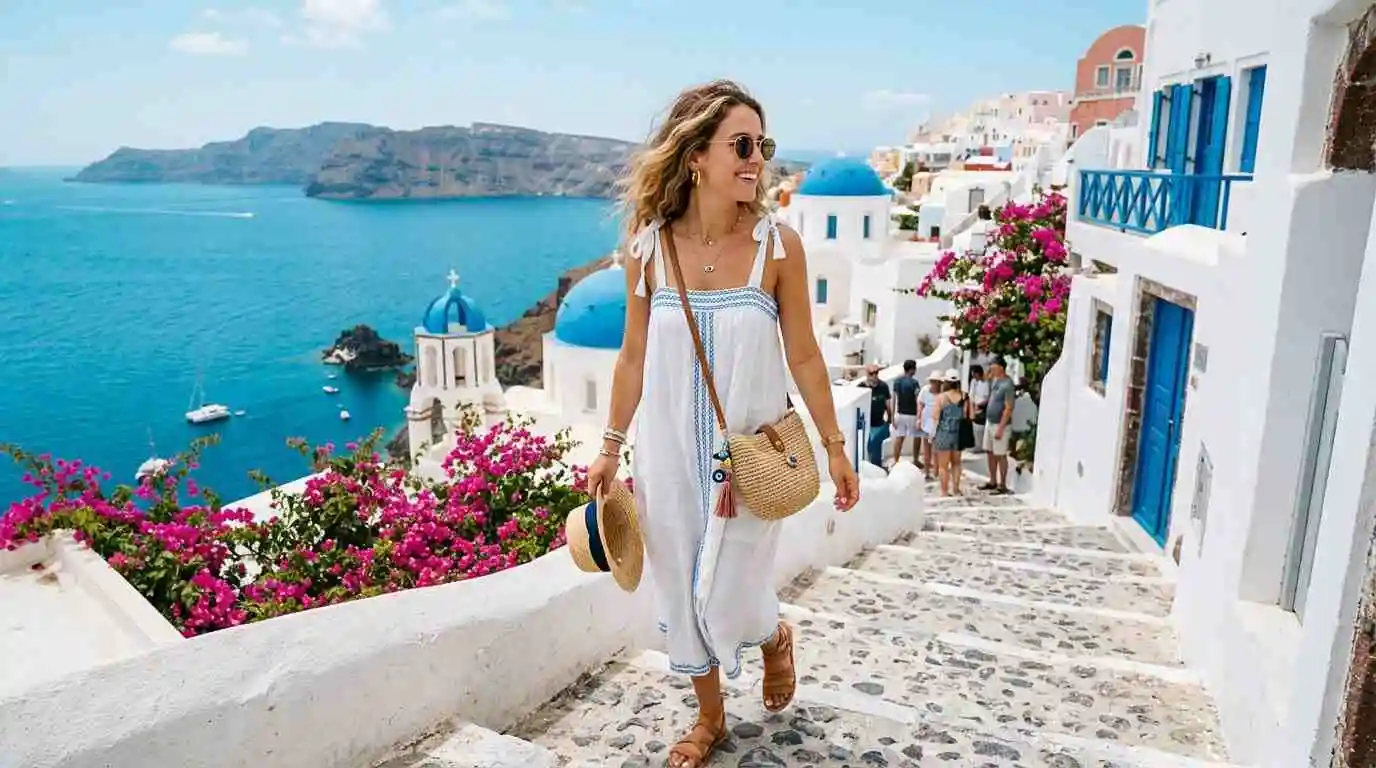
There is no outfit more suited to the Greek islands than a white linen dress and no setting in the world where white photographs with more consistent beauty than against Cycladic architecture.
A white or off-white linen dress — midi length, simple silhouette, breathable construction — worn with flat leather sandals and a woven straw bag. Sunglasses. A wide-brimmed hat for the direct island sun. That is the complete outfit and it requires nothing added to it.
The white linen dress against the whitewashed walls of Oia or Mykonos Town is not a contrast. It is an agreement — the dress and the architecture sharing a colour language that makes every photograph taken in it look considered regardless of how quickly the photograph was actually taken.
The midi length handles the steep stairs of Santorini’s caldera towns and the uneven cobblestones of Mykonos’s old town without restriction. White linen breathes completely in the dry Aegean heat. And the dress converts from morning exploration to afternoon café to sunset viewpoint without requiring a single change.
This is the essential Greece outfit. Everything else in this guide builds on its principles
02. The Cobalt Blue Outfit Against the White
If white is the Greek island foundation, cobalt blue is its essential counterpoint.
The blue domes of Santorini’s churches. The blue shutters and doors that punctuate the whitewashed walls throughout the Cyclades. The Aegean itself, in a blue that shifts from turquoise in the shallows to deep cobalt in open water. Greece’s flag — the same blue and white that defines the entire visual identity of the country.
A cobalt blue dress, or wide-leg cobalt trousers with a white top, or a cobalt linen co-ord — any of these against the white architecture of a Greek island creates the photograph that everyone who visits Greece in summer eventually takes, whether they intended to or not.
The colour works because it belongs. It is not a fashion statement imposed on the landscape. It is the landscape’s own colour worn by the person standing in it. Flat sandals, a minimal woven bag, simple gold jewellery — nothing more is needed when the colour is doing this much work.

Read more about: Spain Summer Outfit Ideas: What to Actually Wear in the Most Vibrant Country in Europe
03. The Boat Day Outfit
The boat trip — around the Santorini caldera, between the small Cycladic islands, along the dramatic coastline of Crete or the Ionian — is one of the essential Greek summer experiences and it requires an outfit built specifically for sun, wind, and water.
A quality swimsuit under a lightweight linen cover-up — the oversized shirt or the simple wrap dress that converts from swimwear cover-up to lunch-stop outfit at the small island taverna where the boat docks for the afternoon meal. Flat sandals that can get wet and dry quickly. A waterproof pouch for the phone. A hat secured well enough to survive the boat’s movement and the meltemi wind. Reef-safe sunscreen — increasingly required at many Greek marine protected areas and simply the more responsible choice for the Aegean’s marine ecosystem.
The boat day in Greek waters involves significant direct sun exposure with little to no shade for hours at a time. The cover-up is not optional styling — it is the practical layer that prevents the sunburn that ruins the rest of the trip. Choose one that you are happy to wear for the majority of the day, because on a boat day, you likely will.

04. The Santorini Sunset Outfit
Santorini’s sunset, viewed from Oia or from any of the caldera-facing terraces across the island, is one of the most photographed natural phenomena in the world and the crowd that gathers to watch it every evening throughout summer has its own specific dress code, observed if not officially stated.
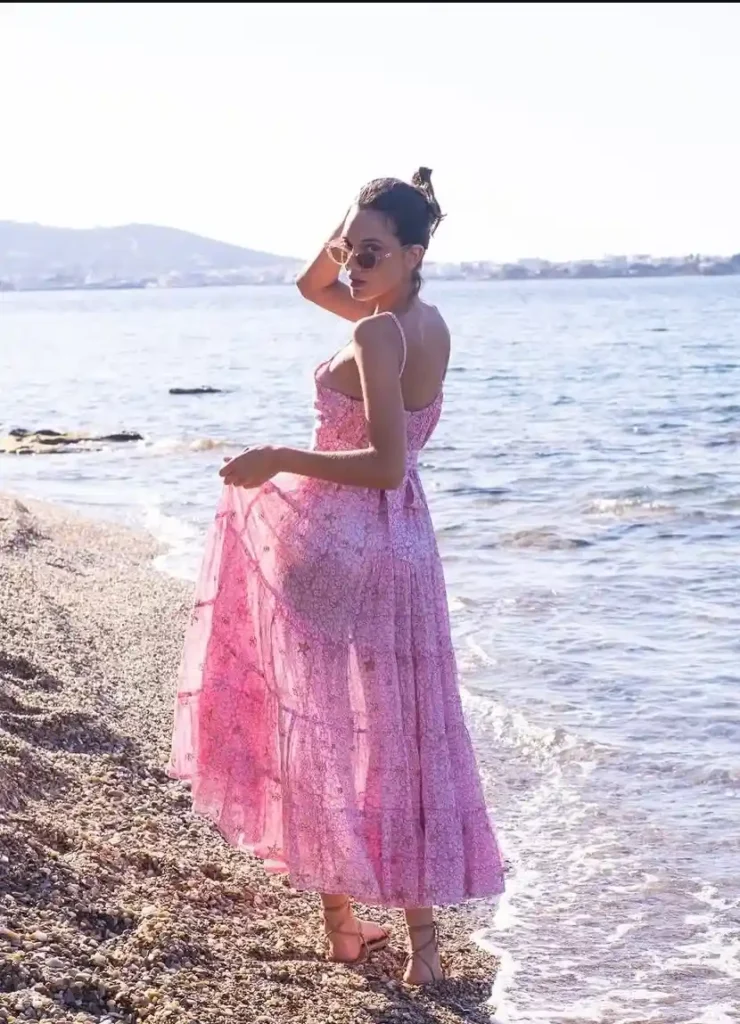
A flowing midi or maxi dress in white, cream, or a warm sunset-adjacent tone — soft gold, dusty rose, pale terracotta — worn with flat leather sandals or simple leather mules. A light wrap or scarf for the breeze that picks up as the sun drops toward the horizon. Minimal jewellery that will not compete with the colour show the sky is about to produce.
The maxi dress here needs to handle the meltemi wind, which is often at its strongest in the early evening. A dress with some weight to the fabric — a good quality cotton or a linen-cotton blend rather than a very lightweight chiffon — moves beautifully without becoming unmanageable. The fully sheer or ultra-lightweight options that work indoors or in calmer settings can become a genuine practical problem on an exposed Santorini viewpoint in a strong evening wind.
This is the photograph that the entire trip may have been partially organised around. Dress for it with the wind in mind as much as the aesthetic.

05. The Athens City Outfit
Athens is not the islands and the outfit that works in the Cyclades is not automatically the correct outfit for the Greek capital.
Athens is a serious, historic, somewhat gritty city of nearly four million people — a place of ancient ruins integrated into a dense modern urban fabric, of significant walking on stone and marble surfaces that have been worn by millennia of foot traffic, of museums and archaeological sites that require both physical stamina and appropriate dress.
The Athens outfit: wide-leg linen trousers or a midi dress in a neutral or warm tone, with comfortable leather sandals or trainers that have genuine grip for the slippery marble paths of the Acropolis. A linen shirt or light jacket for the air-conditioned museums, particularly the Acropolis Museum, which runs notably cool. A crossbody bag rather than a delicate clutch — Athens, like any major capital, requires the practical security of a bag that stays close and stays zipped.
The Acropolis itself deserves specific mention: the marble pathway to the summit is genuinely slippery, has been worn smooth by over two thousand years of visitors, and has claimed more than a few pairs of inappropriate sandals. Wear shoes with real tread. This is not a place for new or smooth-soled footwear.
06. The Linen Co-ord for Greek Island Exploration
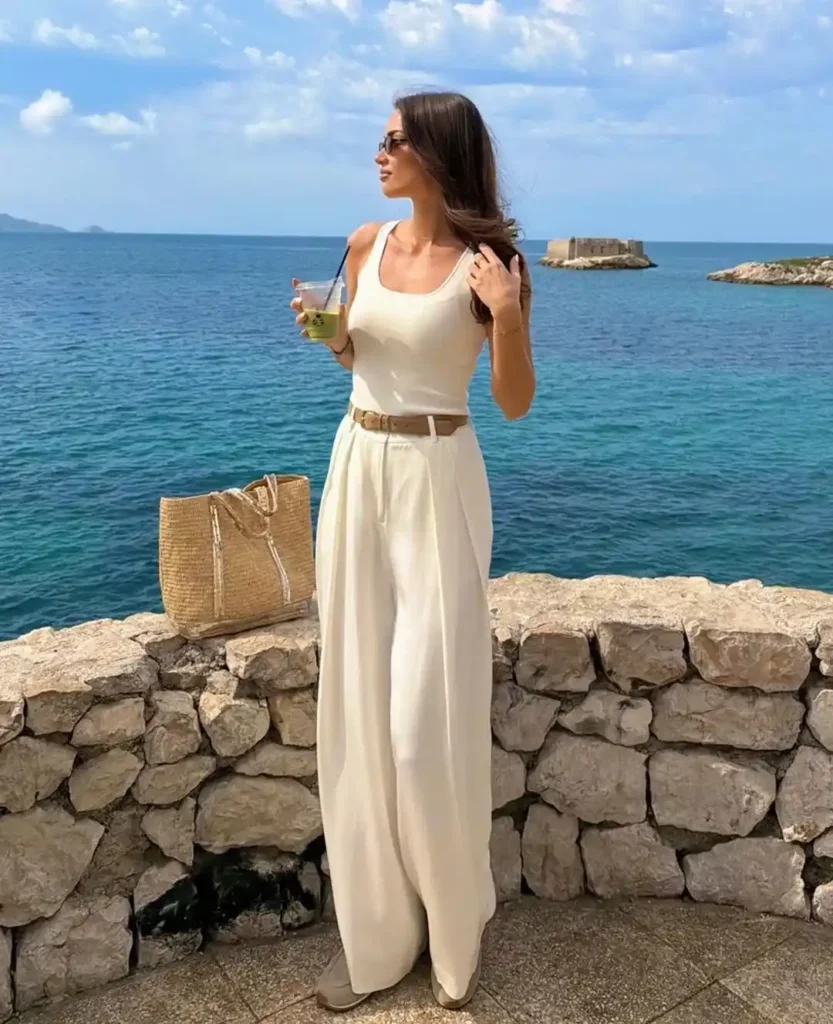
The matching linen co-ord — wide-leg trouser and oversized shirt or fitted top in the same fabric and colour — is the Greek island outfit that creates the most consistent results across the widest range of contexts with the least daily decision-making required.
In white, natural linen, warm cream, or the Greek cobalt blue, the co-ord works across the full Greek island day: morning exploration of the old town, midday lunch at a taverna with a sea view, afternoon walk between viewpoints, evening transition with a slight styling adjustment for dinner.
The pieces separate as efficiently as they combine — the trouser with a swimsuit top for the beach, the shirt knotted over the swimsuit as a cover-up, the trouser with a different top entirely for a day when the co-ord effect is not what the day calls for.
Wear with flat leather sandals and a woven bag for the daytime version. With leather mules and a structured bag for evening. This is the Greek island packing efficiency principle applied directly: two pieces, multiple outfits, minimal suitcase space required.

Read more about: FIFA World Cup Outfits for Women: The Complete Style Guide for Every Match Day
07. The Crochet and Embroidered Detail Outfit
Crochet and embroidered detail pieces — a crochet cover-up, an embroidered linen blouse, a crochet bag — connect contemporary Greek summer dressing to a long tradition of Greek and broader Mediterranean handcraft textile work.
A crochet dress or top, in white or natural tones, worn with flat sandals and minimal jewellery, brings textural interest to an outfit in a way that flat cotton or linen alone does not achieve. An embroidered linen blouse — referencing the traditional embroidery patterns found across the Greek islands, particularly in places like Crete and the Dodecanese — adds a specific cultural texture to an otherwise simple outfit.
This aesthetic works particularly well on the less touristic Greek islands — Naxos, Paros, the smaller Cyclades, Crete’s interior villages — where traditional craft culture remains more visible and more actively practised than on the most internationally famous islands.
Choose pieces in natural, undyed, or soft earth tones rather than the brightest neon crochet that has appeared in some recent resort fashion cycles. The Greek handcraft aesthetic, worn with respect for its origins, sits more comfortably in cream, white, and warm natural tones than in saturated synthetic colour.
08. The Linen Jumpsuit for Effortless Island Days
There are days on a Greek island trip when the decision fatigue of coordinating an outfit is simply not what the day requires, and the linen jumpsuit is the answer to exactly that problem.
A wide-leg linen jumpsuit in white, natural, or a warm summer tone — belted or unbelted depending on preference — worn with flat sandals and a crossbody or tote bag. That is the entire outfit decision, made once, that then handles a full day of beach, café, exploration, and casual dinner without modification.
The jumpsuit packs flat, creates a complete look from a single garment, and photographs as intentional regardless of how little thought actually went into the morning’s dressing decision. On the Greek islands specifically, where days often blur from one beautiful location into the next with limited opportunity for outfit changes, the jumpsuit’s one-decision efficiency is genuinely valuable rather than merely convenient.
Read more about: Portugal Outfit Ideas: What to Actually Wear in One of Europe’s Most Beautiful Countries
09. The Evening Dinner Outfit — Long Greek Nights
Greek dinners do not begin early. The serious eating in Greece — at the family-run taverna, at the more polished restaurant overlooking the caldera, at the beachside fish restaurant where the catch determines the menu — begins after nine and often extends well past midnight, particularly in the islands during peak summer.
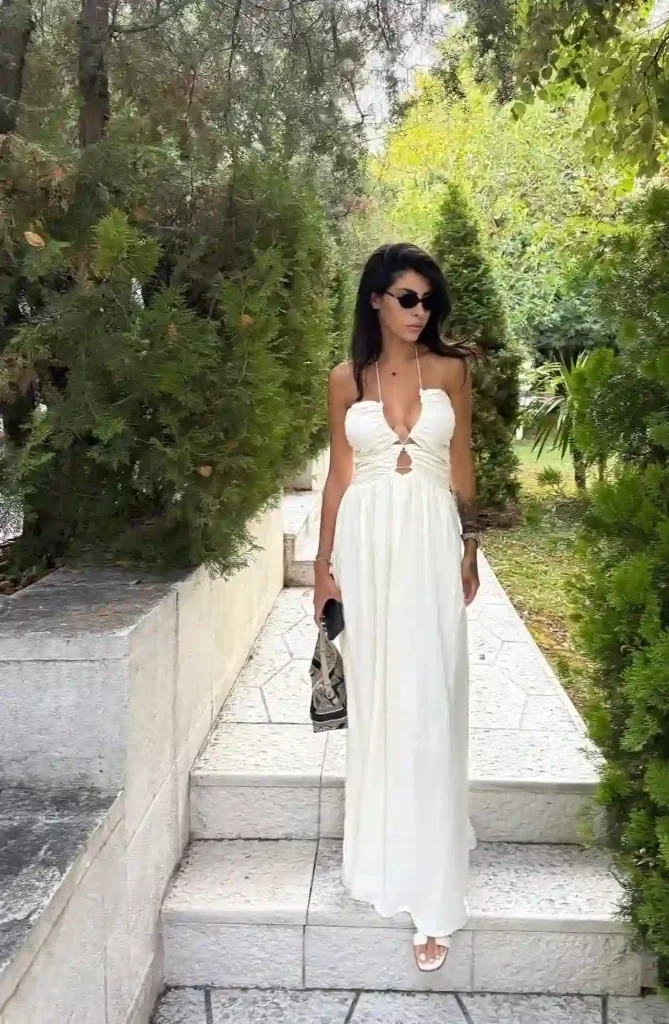
The Greek evening outfit: a silk or satin-adjacent slip dress in a warm tone — soft gold, dusty terracotta, deep cobalt — or a linen co-ord in its most elevated configuration, with leather strappy sandals or pointed-toe leather mules. A minimal clutch or small crossbody. Gold jewellery — Greece’s jewellery tradition, stretching back to antiquity, makes gold feel particularly appropriate here.
The evening in Greece cools from the day’s heat but rarely becomes genuinely cold in summer, even at the latest hours. A light layer — a linen wrap or a simple cardigan — handles the breeze off the water that most Greek island dinner settings, frequently positioned with a sea view, will produce as the night goes on.
This is the outfit for the dinner that becomes a long evening, that becomes a walk through the old town in the warm dark, that becomes one of the specific memories that a Greek summer trip is built from.
10. The Meteora and Monastery Visit Outfit
Meteora — the extraordinary rock formations in central Greece topped by Eastern Orthodox monasteries built directly into the cliff faces, some dating to the fourteenth century — is one of the most visually extraordinary sites in the country and one with the strictest and most specifically enforced dress code.
The Orthodox monasteries of Meteora require, without exception, covered shoulders and knees for all visitors. For women specifically, trousers are frequently not permitted at the monastery entrance regardless of how covered they are — long skirts are required, and several of the monasteries provide wrap skirts at the entrance for visitors who arrive in trousers or shorts.
The practical Meteora outfit: a midi or maxi skirt or dress that already meets the coverage requirement, removing any uncertainty at the entrance. A top with sleeves, or a light cardigan or scarf to cover the shoulders if the top is sleeveless. Comfortable closed-toe shoes for the significant walking and stair-climbing between the different monastery sites, several of which involve hundreds of steps cut into the rock.
This is the Greek outfit built entirely around respect for a specific cultural and religious context, and it is worth getting right before arrival rather than relying on the borrowed wrap skirts at the entrance, which exist as a backup rather than a first choice.
11. The Beach Club Outfit for Mykonos
Mykonos has built an international reputation around its beach club culture — Paradise, Super Paradise, Scorpios, and the dozens of beachfront venues that combine swimming, daytime dining, and an atmosphere that runs from relaxed to genuinely glamorous depending on the specific venue and the hour.
A quality swimsuit, chosen with more consideration than the average beach day given Mykonos’s particular visibility culture, with a lightweight kaftan or sheer cover-up worn over it through the lounging hours. Wedge sandals or flat leather sandals depending on the venue and the terrain between the car park and the beach. A structured sunglasses choice — Mykonos’s beach club culture has a specific relationship with eyewear as a style statement. A woven or structured bag large enough for the day’s essentials.
The Mykonos beach club day extends through the afternoon and frequently into the evening, with many venues transitioning from daytime beach club to evening dining and DJ sets without requiring guests to leave. Packing a slightly more elevated outfit option — a change of jewellery, a wrap dress that goes on over the swimsuit as the sun drops — extends the single beach day outfit into the evening without requiring a return to the accommodation.

Read more about: 2026 Summer Fashion Trends: The Complete Guide to What Is Actually Worth Wearing
12. The Practical Hiking Outfit for Greek Trails
Greece’s islands and mainland offer extraordinary hiking — the Samaria Gorge in Crete, the trails connecting villages on Naxos and Paros, the paths along the caldera rim on Santorini, the ancient routes through the Peloponnese.
A moisture-wicking fitted top or merino base layer with hiking shorts or lightweight trousers in a technical fabric. Proper hiking boots or trail shoes with real grip, broken in well before the trip — Greek trails frequently involve loose scree, smooth worn stone, and significant elevation change. A hat and high-factor sunscreen, as Greek trails offer limited shade for much of their length. A hydration system, as Greek summer heat on an exposed trail dehydrates faster than most hikers from cooler climates anticipate.
The Samaria Gorge specifically is a full-day, sixteen-kilometre hike through one of the longest gorges in Europe, descending significantly through a landscape with limited services and limited shade for much of its length. This is not a hike for sandals or fashion trainers regardless of how the rest of the trip is dressed. Treat it with the seriousness any significant hike deserves.
13. The Final Greek Evening — The Sunset You Came For
Every Greek island trip has the evening that the entire trip was, at least partially, organised around.
The Oia sunset, watched from the right terrace with a glass of Assyrtiko, the local Santorini wine produced from vines grown in the volcanic soil that makes the island what it is. The dinner at the cliffside taverna in a smaller, quieter village where the view is nearly as spectacular and the crowd is a fraction of the size. The last night on the island before the ferry back to Athens.
This evening deserves an outfit built specifically for it.
A flowing dress in white, cobalt, or the warm gold tones of the sunset itself. The best sandals you packed, or leather mules if the terrain allows. The jewellery that has been waiting for this specific evening. A light wrap for the breeze that arrives as the sun finally disappears below the horizon and the temperature drops just enough to notice.
This is not about formality. Greek island dining, even at its most considered, rarely requires it. It is about dressing in a way that matches the significance of the moment — the specific evening that the photographs from this trip will be built around, the one that gets shown to people for years afterward, the one that the whole experience of travelling to Greece in summer was, in some essential way, about reaching.
Read more about: Party Outfit Ideas: The Complete Style Guide for Every Occasion
Practical Tips for Dressing in Greece in Summer
Break in every shoe before Santorini and Mykonos specifically. The combination of steep stairs, worn smooth marble and stone, and significant daily walking distances on Greek islands makes footwear the single most consequence-heavy packing decision for the entire trip.
The meltemi wind is a real consideration, not an exaggeration. Mykonos and the Cyclades generally experience strong, sustained summer winds that genuinely affect what is comfortable to wear, particularly at exposed viewpoints and on boats. Choose fabrics with enough weight to manage in wind, and secure hats with a strap or string.
Cover for the monasteries without exception. Meteora, the monasteries of Mount Athos area views, and many smaller Greek Orthodox churches enforce dress codes strictly. A skirt below the knee and covered shoulders is the simplest way to avoid any issue at any religious site in the country.
Sun protection at sea level is more intense than it appears. The combination of direct Mediterranean sun and reflective surfaces — white architecture, pale stone, water — produces sunburn faster than the temperature alone suggests. Reapply sunscreen consistently, particularly on boat days.
The long Greek dinner deserves planning. Restaurants frequently do not take reservations before nine in peak season and the best tables and the best experiences are often the ones booked or arrived for early. Dress for an evening that will likely run later than initially planned, and bring the light layer that the dropping temperature, however gradual, will eventually call for.
The Greece Summer Colour Palette
The Greece colour palette is, more directly than almost any other European destination, simply the colour palette of the country itself.
The foundation: white and natural linen. These are not merely neutral background colours in Greece — they are the dominant colours of the built environment across the islands, and clothing in these tones photographs with a consistency against Greek architecture that no other colour choice matches.
The essential accent: cobalt and deep Aegean blue. The second half of the white-and-blue visual identity that defines the country from its flag to its architecture to the sea itself.
The warm accents: dusty terracotta, warm gold, soft sunset rose. These are the colours of the Greek evening light specifically — the tones that the setting sun across the Aegean produces and that clothing in these shades catches and amplifies.
The earth tones for the handcraft pieces: natural undyed cream, warm sand, soft olive. These work with the crochet and embroidered detail pieces and connect to the more traditional, less internationally commercial side of Greek island culture.
Build the Greek summer wardrobe primarily from white and blue, add one or two warm sunset tones for evening, and the wardrobe responds to the country in the most direct way available.
Read more about: Europe Vacation Outfit Ideas: The Complete Style Guide for Every Destination
Final Thoughts
Greece offers something that very few destinations manage with this much consistency: a country whose own visual identity is so clear and so coherent that dressing for it correctly is, in large part, simply a matter of paying attention to what is already there.
The white of the architecture. The blue of the domes and the sea. The gold of the evening light over the Aegean. The handcraft traditions of the islands that have been practised for generations. None of this requires invention. It requires noticing, and then dressing in a way that responds to what has been noticed.
The thirteen outfits in this guide are starting points. The white linen dress in the cut that suits the wearer. The cobalt piece in the shade of blue that feels most personal. The evening outfit for the sunset that the entire trip has, in some way, been building toward.
Pack for the heat. Pack for the wind. Pack shoes that can handle stairs cut into volcanic rock and marble worn smooth by millennia of footsteps. Cover appropriately for the monasteries. And let the white and the blue and the gold of the Greek evening light do most of the remaining work.
Greece has been dressed in white and blue for longer than fashion has existed as a concept. Join it.
Go simply. Dress for the light. Let the Aegean do the rest.